You wake up already tense. Your shoulders are locked somewhere near your ears, your jaw is clenched before you’ve said a single word, and your body feels like it spent the night bracing for impact rather than resting. You’ve tried yoga. You’ve tried stretching. You’ve tried deep breathing. And yet something still feels stuck — not in your muscles exactly, but somewhere deeper, somewhere words don’t quite reach.
That feeling is real, and it makes complete sense. Your body has been keeping score long before you became aware of it. Stress, loss, overwhelm, and years of pushing through have all left their imprint — not just in your thoughts, but in your tissue, your posture, your breath patterns, and your nervous system.
Somatic yoga offers something different from what you’ve tried before. It’s a practice that works from the inside out, combining the ancient wisdom of yoga with modern neuroscience to help your body finally release what it’s been holding. I’m Sofia, a certified somatic yoga teacher and nervous system coach, and I’ve watched this practice quietly change lives — including my own.
In this article, you’ll learn exactly what somatic yoga is, how it differs from traditional yoga, why it works on a nervous system level, and how to begin experiencing its healing benefits today.
Table of Contents
What Is Somatic Yoga and Why Is Everyone Talking About It
Somatic yoga is a body-centered movement practice that combines traditional yoga postures with somatic principles — meaning it prioritizes your internal experience of movement over the external shape your body makes. The word “somatic” comes from the Greek soma, meaning living body, and that distinction matters enormously.
In a conventional yoga class, the goal is often to achieve a pose. In somatic yoga, the goal is to feel the pose — to notice what’s happening inside as you move, breathe, and settle. This shift from performing to sensing is where the real healing begins.
Traditional yoga asks your body to follow instructions. Somatic yoga asks your body to lead.
The Role of the Nervous System in Somatic Yoga
Your nervous system governs everything — how safe you feel, how your muscles hold tension, how deeply you can breathe, how well you sleep. When chronic stress keeps your nervous system locked in a sympathetic state (the fight-or-flight response), your body stays braced even when there’s no actual threat.
Somatic yoga works directly with this system. Through slow, intentional movement and breath, it signals to your nervous system that it is safe to soften. Research published in the International Journal of Yoga found that mindful movement practices significantly reduce cortisol levels and shift the body toward parasympathetic dominance — the rest-and-digest state where healing actually happens.
The 7 Powerful Ways Somatic Yoga Heals Your Body
Here is where the practice earns its reputation. Somatic yoga doesn’t just stretch muscles or build flexibility — it works on layers that conventional movement rarely touches.
1. It Releases Chronic Muscle Tension
Muscles that have been braced for years — from stress, trauma, poor posture, or emotional suppression — don’t release through stretching alone. Somatic yoga uses a technique called pandiculation: a slow, conscious contraction followed by an even slower release. This resets the motor cortex’s resting level of muscle tension in a way that passive stretching simply cannot replicate.
2. It Rewires the Stress Response
Every time you move slowly and with awareness while staying calm, you teach your nervous system a new pattern. You’re essentially creating evidence for your body that movement doesn’t have to mean urgency. Over time, this recalibrates your baseline stress response — you become less reactive, more resilient.
3. It Processes Stored Emotional Tension
Have you ever held a hip-opening pose and suddenly felt an unexpected wave of emotion? That’s not coincidence. The body stores emotional residue — particularly in the hips, chest, and jaw. Somatic yoga creates a safe, slow container for that stored tension to surface and move through. You don’t have to analyze it; you just have to let it move.
4. It Improves Body Awareness (Interoception)
Interoception is your ability to sense what’s happening inside your body — hunger, tension, emotion, breath quality. Research from Harvard Medical School has linked poor interoceptive awareness to anxiety, depression, and chronic pain. Somatic yoga is one of the most effective tools for rebuilding this inner sense, giving you a kind of early warning system for stress before it escalates.
5. It Supports Trauma Recovery
Somatic yoga is particularly valuable for anyone navigating trauma. Because trauma is held in the body — not just the mind — talk therapy alone often isn’t enough. Slow, titrated movement that keeps the nervous system within its window of tolerance allows the body to process what words cannot reach. I always recommend working with a trauma-informed teacher for this aspect of the practice.
6. It Reduces Chronic Pain
Many cases of chronic pain — particularly in the back, neck, and hips — are rooted in neuromuscular holding patterns rather than structural damage. By releasing those patterns at the source, somatic yoga can reduce pain in ways that physical therapy or massage, while helpful, don’t always address. The brain is learning to let go, not just the muscle.
7. It Improves Sleep Quality
When your nervous system stays wound up, sleep suffers. A gentle somatic yoga practice before bed — even ten minutes of slow, floor-based movement — sends a clear signal to your brain that the day is done. Many of my students report deeper, less interrupted sleep within the first two weeks of a consistent evening practice.
Sofia’s Personal Story: The Practice That Changed Everything
I didn’t come to somatic yoga because I was curious about it. I came to it because I was desperate.
Several years ago, I was teaching yoga five days a week, holding down a demanding schedule, and quietly falling apart. I looked fine on the outside — flexible, strong, calm in front of a class. But inside I was running on fumes and cortisol. I had jaw pain, persistent insomnia, and a low-grade anxiety that never fully lifted even when life was technically going well.
A mentor suggested I try somatic movement work. I was skeptical. I thought I already did “enough” body awareness in my yoga practice. What I discovered was that there’s a profound difference between moving through a pose correctly and actually inhabiting your body. The first time I did a simple somatic floor sequence — just ten minutes of slow pelvic rocking, breath tracking, and pandiculation — I cried. Not from pain, but from relief. Something that had been gripped for years let go even slightly, and that slight release was enough to remind me what settled felt like.
That’s when I rebuilt my entire teaching approach around somatic principles, and I have never looked back.
How to Start a Somatic Yoga Practice Today
You don’t need a studio, expensive equipment, or prior yoga experience. You need a mat, ten minutes, and a willingness to feel.
Here is a simple five-step somatic yoga sequence you can try right now.
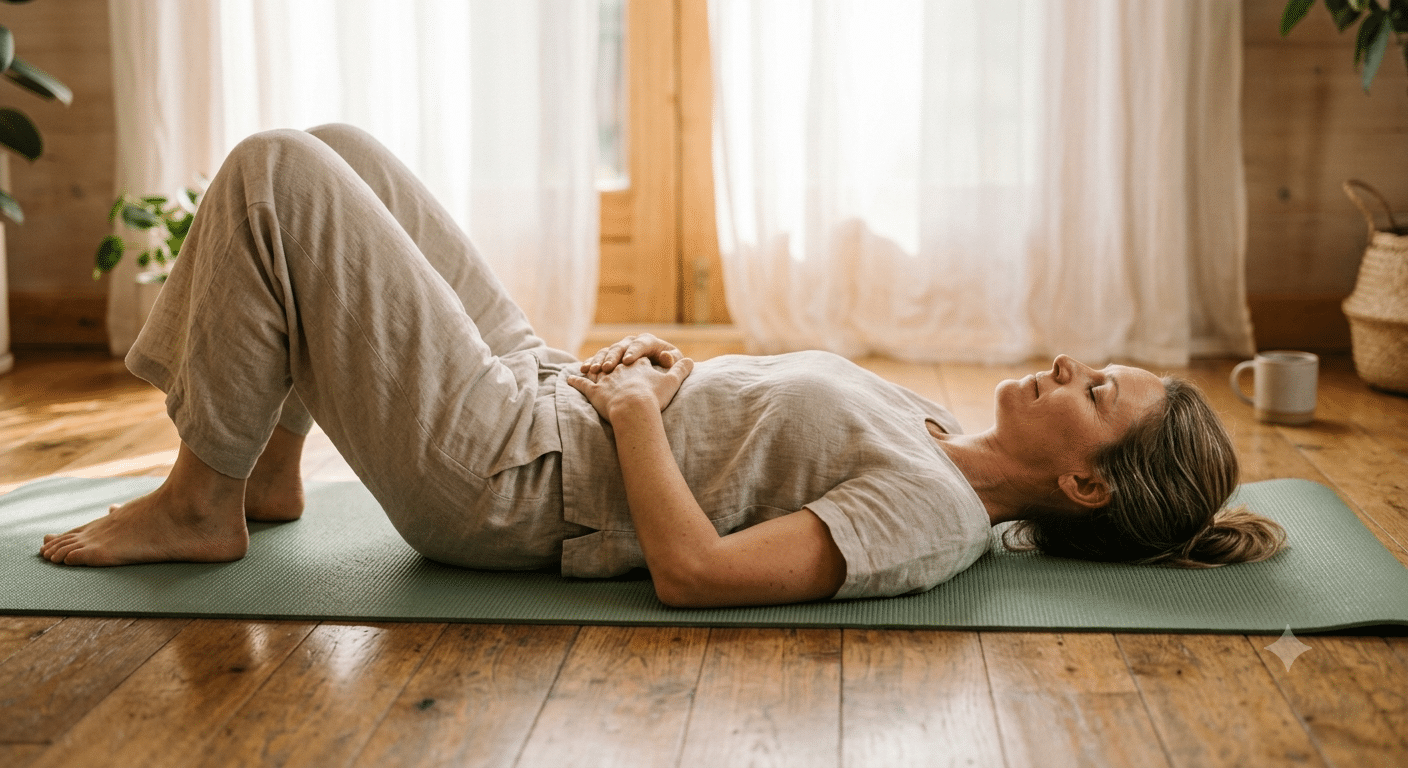
Step 1: Arrive in stillness. Lie on your back with your knees bent, feet flat on the floor. Close your eyes and simply notice. What do you feel? Where is your body in contact with the ground? Don’t try to change anything yet — just observe for two full minutes.
Step 2: Scan from feet to skull. Slowly bring your awareness from your feet upward, pausing at each area for a breath or two. Notice where you feel ease and where you feel resistance, holding, or numbness. This is your baseline.
Step 3: Begin gentle pelvic tilts with intention. Slowly tilt your pelvis forward, creating a small arch in your low back, then tilt it back, pressing your low back gently toward the floor. Move at half the speed you think you should. As you tilt back, let your breath release. This is pandiculation in its simplest form.
Step 4: Add a conscious pause. After five or six cycles, stop completely. Rest in stillness and notice what has changed. This pause is not passive — it is the moment your nervous system integrates the movement. Don’t rush it.
Step 5: Close with three breaths of gratitude. Before you rise, take three slow exhale-emphasized breaths. Let each exhale be twice as long as your inhale. This activates the vagus nerve and anchors the parasympathetic signal your practice has been building.
💚 Sofia’s Tip: The most common mistake beginners make in somatic yoga is moving too fast. If you can feel every millimeter of the movement, you’ve found the right pace. If the movement feels automatic or easy, slow down by half. The healing happens in the sensation, not the range of motion.
Somatic Yoga for Anxiety, Burnout, and Chronic Stress
What makes somatic yoga particularly suited for anxiety and burnout is that it doesn’t ask you to perform wellness. It asks you to feel what’s real. And paradoxically, that honest meeting with your actual experience — rather than pushing past it or fixing it — is what allows the nervous system to finally soften.
Women navigating burnout often come to somatic yoga exhausted by effort. They’ve been trying harder — harder at work, harder at self-care, harder at healing. Somatic yoga offers a radical alternative: try less, feel more. The body doesn’t need to be conquered; it needs to be heard.
What does that look like in practice? It looks like slowing a cat-cow stretch down so much that you feel each individual vertebra articulate. It looks like staying in a pose for longer than feels productive and noticing what shifts when you stop rushing. It looks like discovering that your left hip holds tension differently than your right, and getting curious about that rather than correcting it.
Who Can Practice Somatic Yoga
Somatic yoga is genuinely accessible to almost everyone. Because the emphasis is on internal sensation rather than physical achievement, it adapts naturally to every body. You don’t need flexibility, strength, or prior experience. You need curiosity and a willingness to slow down.
It is especially well suited for women navigating anxiety, chronic stress, burnout, PTSD, chronic pain, perimenopause, or insomnia. It works beautifully for complete beginners and for experienced yogis who feel something is still missing from their practice.
For older adults and seniors who want a gentle nervous-system-focused movement practice, somatic yoga is a wonderful option.
One important note: if you are working through significant trauma, please seek out a trauma-informed somatic practitioner alongside your home practice. The practice is safe, but having skilled support can make the process gentler and more sustainable.
Key Takeaways
→ Somatic yoga prioritizes internal sensation over external pose achievement, making it a uniquely healing form of movement.
→ It works directly with the nervous system to shift the body from chronic stress (sympathetic) into rest and healing (parasympathetic).
→ Techniques like pandiculation reset chronic muscle tension at the neurological level, not just the physical one.
→ Regular somatic yoga practice improves interoception, reduces anxiety, supports trauma recovery, and deepens sleep quality.
→ Anyone can begin somatic yoga today with just a mat and ten minutes — no prior experience required.
Conclusion
Somatic yoga is not another wellness trend asking you to do more, push harder, or achieve a better version of yourself. It is an invitation to return — to your body, to your breath, to the quiet intelligence that has been waiting patiently beneath all the noise.
You don’t need to practice perfectly. You don’t need to do it every day from the very first week. You simply need to begin gently, return consistently, and trust that your body knows how to heal when you finally give it the space to do so.
Start with the five-step sequence in this article tonight. Ten minutes is enough. Put your phone in the other room, lie down on your mat, and let your body lead for once. Notice what shifts — even slightly. That slight shift is the beginning of something real.
There is so much more to explore — poses, sequences, nervous system science, and practices for specific struggles. Come back to SomaticYogaFlow.com often, and leave a comment below to share what you noticed in your first practice.

FAQ About Somatic Yoga
What is the difference between somatic yoga and regular yoga?
Regular yoga typically guides students toward specific external shapes and alignment cues, measuring progress by how closely the body matches the intended pose. Somatic yoga shifts the focus entirely inward — the goal is to sense and feel the movement rather than achieve it. This makes somatic yoga particularly effective for stress relief, trauma recovery, and chronic tension because it communicates directly with the nervous system rather than primarily training the muscles.
Is somatic yoga good for anxiety?
Somatic yoga is one of the most effective movement practices for anxiety because it works directly with the nervous system. Slow, intentional movement paired with breath awareness activates the parasympathetic nervous system — the body’s rest-and-digest state — which counteracts the chronic activation that drives anxiety. Many people notice a reduction in physical anxiety symptoms like jaw tension, shallow breathing, and tight shoulders within just a few sessions of consistent practice.
Can beginners do somatic yoga?
Somatic yoga is actually ideal for beginners because it requires no prior experience, flexibility, or strength. Since the practice centers on internal awareness rather than physical performance, there are no poses to get right or wrong. Beginners often find somatic yoga more approachable than traditional yoga classes because the pace is slower and the emphasis is on curiosity rather than achievement. Starting with a simple floor-based sequence of ten to fifteen minutes is all you need.
How long does it take for somatic yoga to work?
Many people notice subtle shifts — a sense of softening, deeper breath, or reduced muscle tension — within their very first session. More lasting changes to chronic tension patterns and stress responses typically build over two to six weeks of consistent practice. Research on nervous system regulation suggests that even brief daily sessions of mindful movement create measurable changes in cortisol levels and autonomic nervous system tone within a month of regular practice.
What is somatic yoga good for?
Somatic yoga is particularly beneficial for chronic stress, anxiety, burnout, trauma recovery, chronic pain, insomnia, and emotional tension that feels stuck in the body. It also supports perimenopausal symptoms, jaw tension, low back pain, and the kind of persistent fatigue that sleep alone doesn’t fix. Because it works through the nervous system rather than just the muscles, its benefits extend into emotional regulation, mood stability, and a greater sense of safety and ease in your own body.