Your shoulders live somewhere up around your ears. Your jaw aches by mid-afternoon, and you cannot remember the last time you took a full, easy breath without thinking about it first. You have tried to relax a hundred different ways, and your body simply will not listen.
I want you to know something important: this is not a willpower problem. Your nervous system has been running on high alert for so long that it no longer knows how to come back down on its own, and no amount of thinking your way to calm will change that. The body got you stuck here, and the body is what will get you out.
This is exactly where a somatic yoga nervous system reset comes in. Unlike a typical yoga class focused on flexibility or strength, this practice speaks directly to your nervous system through slow, felt movement rather than instruction alone. By the end of this article, you will understand why your body holds onto stress the way it does, and you will have a complete ten-step practice you can use today to help your system finally exhale.
Table of Contents
What a Somatic Yoga Nervous System Reset Really Means
A somatic yoga nervous system reset is not about achieving a perfect pose or holding a stretch until it burns. It asks a completely different question: what does my body need to feel safe right now? That single shift changes everything about how the practice feels and works.
Somatic simply means “of the body,” and somatic yoga uses small, exploratory movements guided by internal sensation rather than external appearance. You are not trying to look like anyone else on a mat. You are listening to your own nervous system and responding to what it tells you, one gentle movement at a time.
I often tell my students that somatic movement is a conversation, not a performance. Your nervous system has been trying to talk to you through tension, fatigue, and restlessness, and this practice simply gives you a way to finally answer back.
How Your Nervous System Gets Stuck in Survival Mode
Have you ever noticed that you can feel anxious for no obvious reason, even when nothing is currently wrong? This happens because your nervous system operates on old information, storing patterns from past stress and replaying them long after the original danger has passed.
Your autonomic nervous system has three main states: fight or flight, freeze, and the calm, connected state called ventral vagal. Most of us with chronic stress or anxiety spend far too much time cycling between the first two, rarely landing in that third, restorative state where digestion, sleep, and clear thinking actually happen. A somatic yoga nervous system reset works by gently signaling safety to your body until it remembers how to find that calm state again.
This is not something you can think your way into, no matter how logical the reasoning sounds. Your nervous system responds to felt experience, movement, breath, and vibration, which is precisely why a somatic approach succeeds where pure mindset work often stalls.
The Science Behind a Somatic Yoga Nervous System Reset
I know some of you want more than my word for this, and I respect that completely. Boston University researcher Chris Streeter studied yoga’s effects on the brain and found that participants practicing yoga consistently over twelve weeks showed measurable increases in GABA, a neurotransmitter directly linked to reduced anxiety and improved mood.
That finding matters because it shows something remarkable: this is not simply a feeling of relaxation, it reflects an actual chemical shift inside your nervous system. Slow, mindful movement combined with breath genuinely changes your brain chemistry over time, not just your mindset in the moment.
This is also connected to something called vagal tone, which describes how efficiently your vagus nerve helps you shift between stress and calm. Somatic yoga practices, particularly ones involving slow spinal movement and diaphragmatic breathing, are shown to improve vagal tone, and a stronger vagal tone means your body recovers from stress far more quickly.
Signs Your Body Is Asking for a Nervous System Reset
Sometimes we push through so many small signals that we stop noticing them as signals at all. Chronic tension in your neck and shoulders, shallow breathing, trouble falling asleep even when exhausted, and feeling irritable over small things can all point to a nervous system stuck in overdrive.
Digestive issues without a clear medical cause often trace back to this same dysregulation, since your digestive system only functions well when your body feels safe. Feeling emotionally numb or disconnected from your own body is another quieter sign, one that often gets overlooked because it does not feel dramatic or urgent.
I remember a client named Rina who came to me convinced her constant fatigue was simply a busy-life problem. Within a few weeks of somatic practice, she realized her body had been so tightly braced for so long that basic rest had never actually reached her nervous system, and that recognition alone changed how she approached her recovery.
My 10-Step Somatic Yoga Nervous System Reset Practice
This is the exact practice I return to whenever my own system feels overwhelmed, and I have refined it over years of teaching. Give yourself fifteen to twenty quiet minutes, ideally somewhere you will not be interrupted.
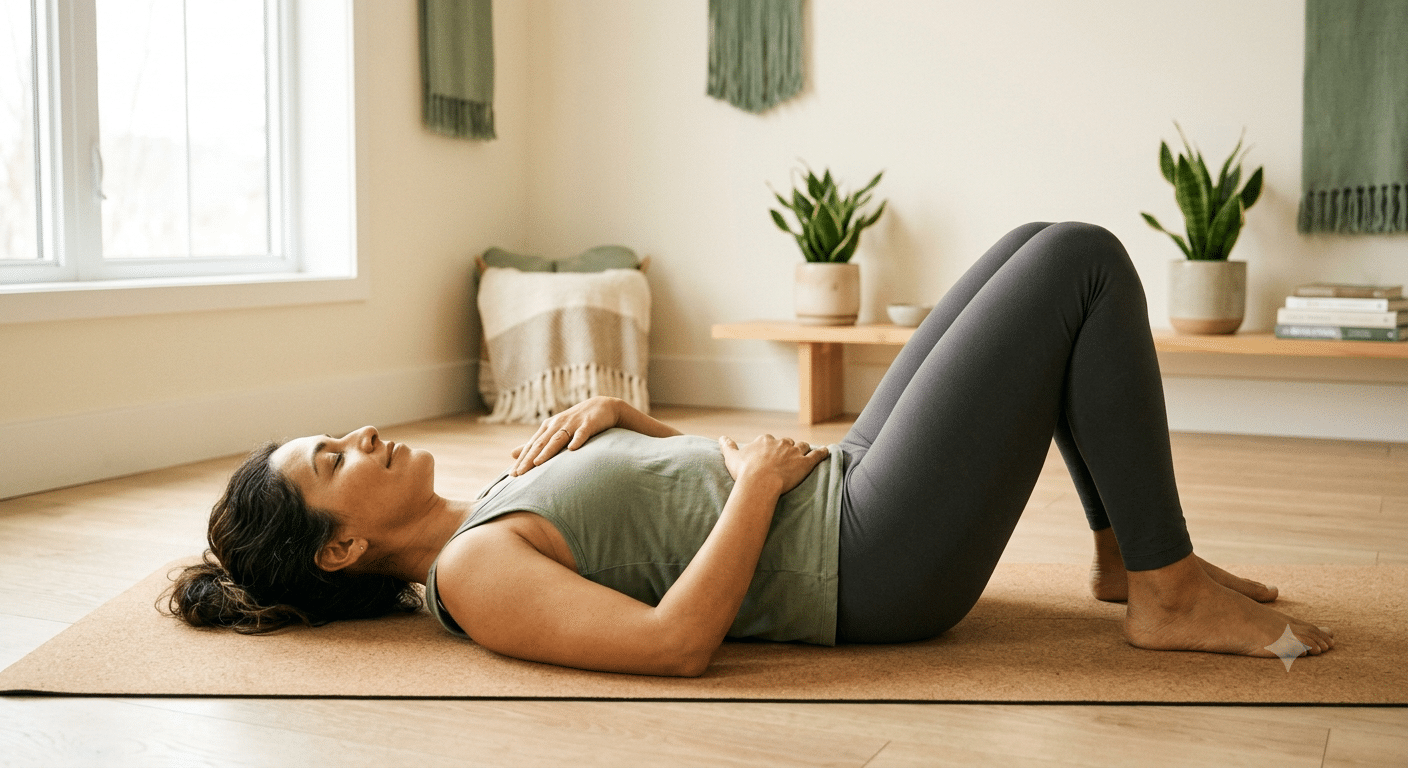
- Lie on your back with knees bent and feet flat, then place one hand on your chest and one on your belly.
- Breathe slowly through your nose, noticing which hand rises more, without trying to change anything yet.
- Gently rock your pelvis forward and back a few inches, following your own natural rhythm rather than a set count.
- Slowly roll your head from side to side, letting your neck release with each small movement.
- Bring your knees toward your chest and sway them gently side to side, keeping the motion small and unhurried.
- Place your feet flat again and press them softly into the floor, noticing the support beneath you.
- Bring one arm overhead in a slow arc while keeping your ribs relaxed, then switch sides.
- Return to stillness and lengthen your exhale until it becomes slightly longer than your inhale.
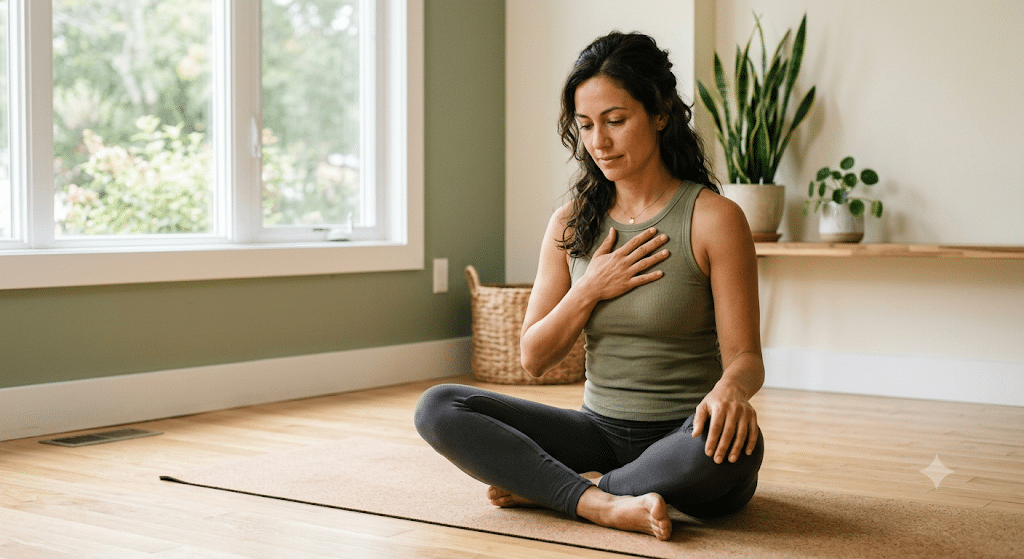
- Place a hand over your heart and simply notice your heartbeat for several breaths.
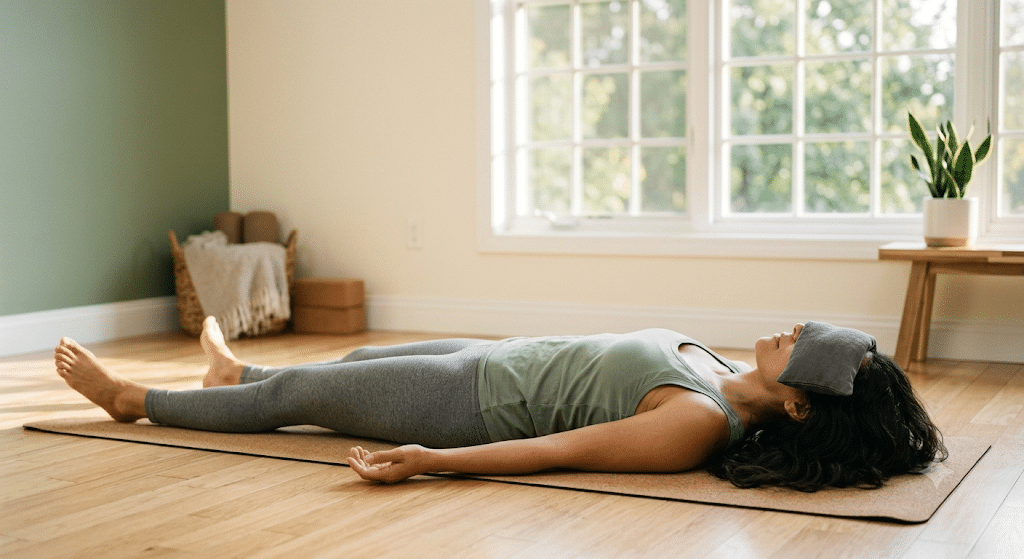
- Rest completely still for two full minutes, allowing your body to integrate everything it just experienced.
💚 Sofia’s Tip: If any step feels rushed, slow it down even further. This practice rewards patience far more than precision.
Somatic Yoga Nervous System Reset Tools That Help
You do not need special equipment for somatic yoga, but a few simple tools make the experience noticeably deeper. I always begin my practice on a cork yoga mat, since the natural texture gives me an instant sense of grounding that synthetic mats simply cannot replicate.
For the reclined portions of this practice, placing a yoga bolster beneath your knees completely changes the experience, allowing your lower back to release in a way that feels almost effortless.
If you have never tried an eye pillow during the final resting step, I genuinely encourage you to, because the gentle weight signals your nervous system that it is finally safe to let go.
Common Mistakes That Block Your Nervous System Reset
The most common mistake I see is treating this practice like exercise, pushing through discomfort instead of adjusting the movement. Somatic work asks you to reduce effort, not increase it, and that reversal trips up even experienced yogis at first.
Rushing through the steps defeats the entire purpose, since your nervous system needs time, not speed, to register safety. Practicing while distracted by your phone or a mental to-do list also weakens the results, because full attention on internal sensation is what makes the work somatic in the first place.
Another quiet mistake is expecting instant results after a single session. Real nervous system change happens gradually, through repetition, much like the twelve-week timeline in the research I mentioned earlier.
Making Your Nervous System Reset a Daily Habit
Consistency matters more than duration here, and that should come as good news. Five focused minutes every day will change your nervous system far more than one long session every few weeks.
I encourage my students to anchor this practice to something they already do, like right after brushing their teeth or right before checking their phone in the morning. That small pairing removes the decision fatigue that so often derails new habits before they can take root.
Will this feel strange at first, especially if you are used to more active forms of exercise? Almost certainly, and that is completely normal, since your nervous system is learning an entirely new pattern.
Key Takeaways
→ Your nervous system responds to felt experience, not just thoughts
→ Somatic yoga measurably increases GABA and improves vagal tone
→ The 10-step practice takes just 15–20 minutes and needs no experience
→ Consistency matters more than intensity or duration
→ Small daily repetition rewires stress patterns over time
Coming back into your body is one of the most powerful things you can do for your long-term wellbeing. You do not need to be perfect at this, and you certainly do not need to do it flawlessly every single day; you only need to keep showing up gently and consistently.
Your nervous system has been waiting a long time for permission to finally settle. Give yourself fifteen quiet minutes today, try even three of these steps, and notice what shifts. I would love to hear how it feels for you, so come share your experience in the comments or explore more somatic practices here on SomaticYogaFlow.com.
Frequently Asked Questions
What is a somatic yoga nervous system reset?
It is a gentle practice combining slow, internally guided movement with breath to help your autonomic nervous system shift out of stress states and into a calmer, more regulated state. Unlike traditional yoga, it prioritizes internal sensation over external alignment or appearance. Most people can begin practicing it immediately, with no prior yoga experience required.
How long does it take to reset your nervous system with yoga?
Research on yoga’s effects on the brain, including GABA levels, generally uses a twelve-week timeline for measurable change, though many people notice reduced tension and better sleep within just a few sessions. Daily practice, even for five to ten minutes, tends to produce faster and more lasting results than occasional longer sessions. Patience and consistency matter more than any single practice.
Can somatic yoga help with anxiety and chronic stress?
Yes, somatic yoga is widely used to support anxiety and chronic stress because it directly targets the nervous system rather than only addressing thoughts or behavior. By improving vagal tone and increasing calming neurotransmitters like GABA, it helps the body return to a more regulated baseline. Many people use it alongside therapy or other treatment as a complementary practice.
What is the difference between somatic yoga and regular yoga?
Regular yoga often emphasizes strength, flexibility, and precise alignment in poses, while somatic yoga prioritizes small, internally guided movements based on sensation rather than appearance. Somatic yoga tends to move much more slowly and includes fewer, simpler movements repeated with full attention. The goal is nervous system regulation rather than physical fitness in the traditional sense.
Do I need any equipment to start a somatic yoga practice?
No special equipment is required to begin, and you can start with nothing more than a comfortable floor space and loose clothing. A soft mat, bolster, or eye pillow can deepen comfort and support during certain movements, but they are optional additions rather than requirements. Many people successfully practice using just a folded blanket at home.