Your shoulders live somewhere up near your ears now. Your jaw aches by mid-afternoon and you cannot quite remember when you last took a full, unguarded breath. Stress has a way of moving into the body and unpacking its bags, settling into tissue long after the stressful moment has technically passed.
I want you to know that this response is not a personal failing. Your nervous system did exactly what it was designed to do — it braced for something and then never got the clear signal that it was safe to release. That bracing pattern, repeated day after day, is what turns ordinary tension into the kind of chronic tightness that no amount of willpower seems to touch.
This is where somatic yoga becomes so different from anything you may have tried before. Rather than pushing your body into a shape from the outside, somatic movement works from the inside out, using slow, felt-sense awareness to help your nervous system finally recognize that the danger has passed. In this article, you will learn nine somatic yoga poses specifically chosen for stress relief, along with the science behind why they work and a simple five-step practice you can use today.
Table of Contents
Understanding Somatic Yoga for Stress Relief
Somatic yoga asks a different question than traditional yoga. Instead of “how does this pose look,” it asks “how does this movement feel from the inside.” That shift in attention is not just a nicety — it is the entire mechanism of how somatic practice calms the body.
Research published in Frontiers in Human Neuroscience found that slow, interoceptive movement practices measurably lower activity in the sympathetic nervous system, the branch responsible for your fight-or-flight response. This matters because chronic stress keeps that branch dialed up long after the original trigger disappears. Somatic awareness gives your brain new information, letting it recalibrate what safety actually feels like in the body.
I always tell my students that somatic yoga is less about achieving a pose and more about noticing one. Isn’t it strange how much of modern life trains us to override our own physical signals? Somatic practice reverses that, and stress relief follows naturally once the body stops being ignored.
Why Traditional Stress Management Often Falls Short
Most stress advice focuses entirely on the mind — think positive, breathe deeply, journal it out. These tools have real value, but they frequently skip over where stress actually lives, which is in muscle, fascia, and the nervous system itself.
A 2021 study in the Journal of Bodywork and Movement Therapies noted that somatic-based interventions produced greater reductions in perceived stress than cognitive-only approaches among participants with chronic tension patterns. The body, it turns out, needs its own language of release, not just a mental instruction to relax.
This is why so many of my clients arrive having already tried meditation apps, breathing exercises, even therapy, and still feel that low hum of tension in their chest. Somatic yoga fills that gap by speaking directly to the tissue holding the stress.
Pose One — Supported Child’s Pose with Pandiculation
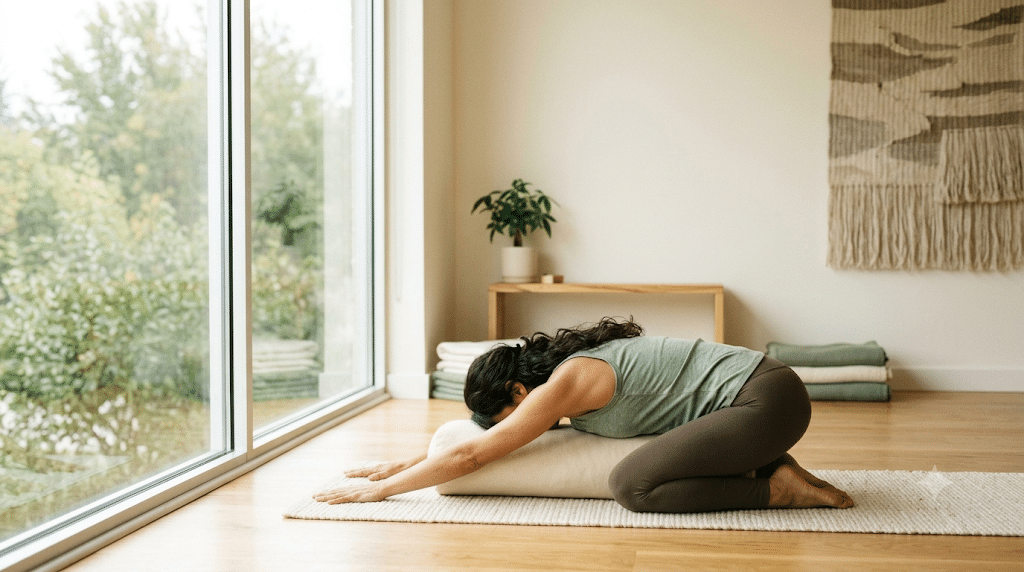
Begin on your knees with a bolster or folded blanket beneath your torso, letting your forehead rest gently on your forearms. Rather than holding the shape statically, slowly extend one arm forward as far as comfortable, then release, alternating sides in a gentle stretching-and-releasing rhythm known as pandiculation.
This wave-like extension and release mimics what your body does naturally when it wakes from sleep, which is precisely why it feels so instinctively soothing. Hold each extension for three slow breaths before releasing completely.
Pose Two — Somatic Cat-Cow with Micro-Movements
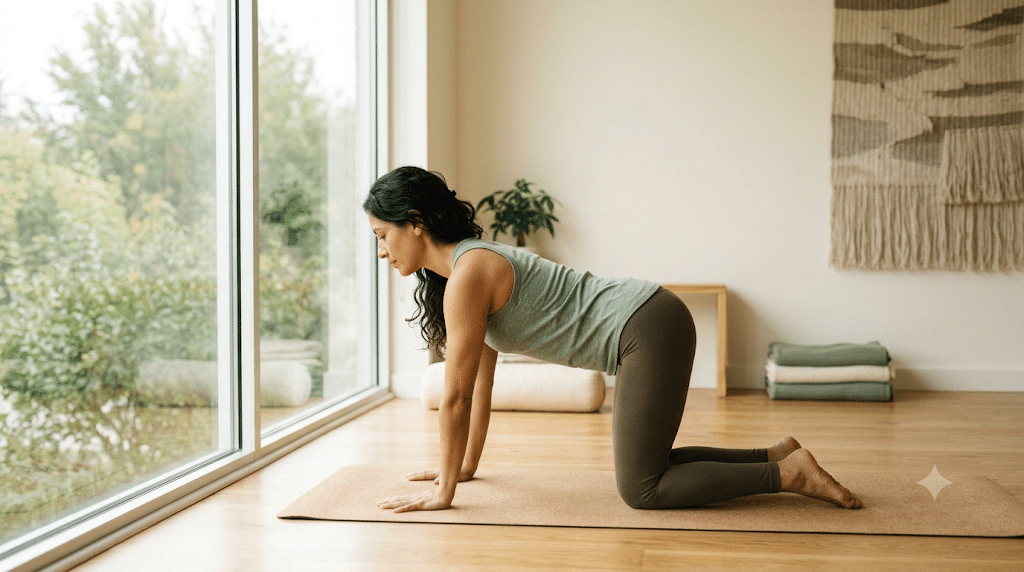
Come onto your hands and knees and instead of the traditional full-range cat-cow, slow the movement down to a quarter of its usual size. Notice the exact point in your spine where movement wants to happen and let that be your entire focus.
I remember teaching this to a student named Diane who told me she had done cat-cow for years without ever actually feeling her spine move. Slowing it down that dramatically was, in her words, the first time yoga had ever felt like it belonged to her body specifically. Micro-movement work like this retrains proprioception in a way that big, fast stretches simply cannot.
Pose Three — Constructive Rest Position
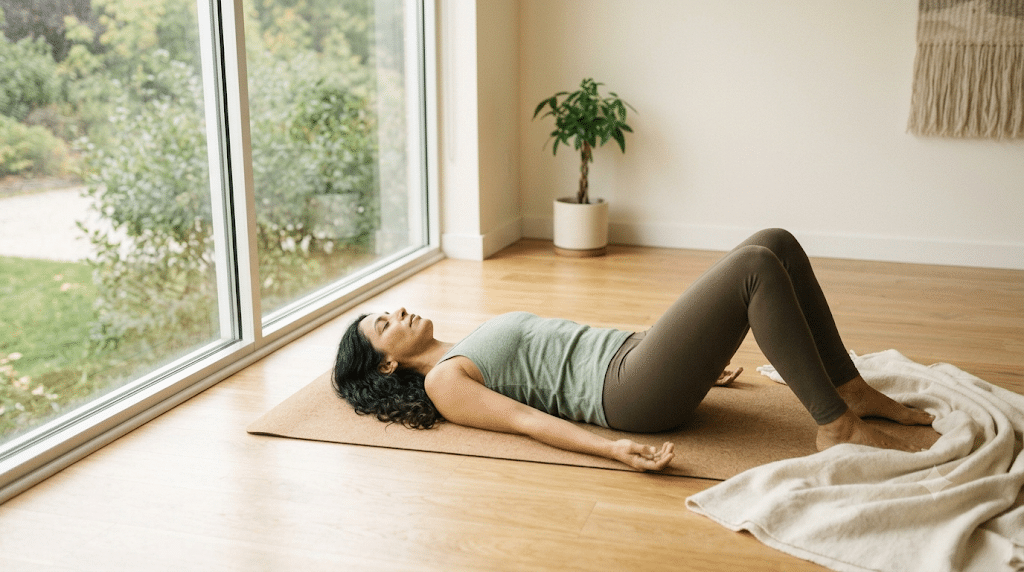
Lie on your back with your knees bent and feet flat on the floor, letting your spine settle heavily into the ground beneath you. This position, borrowed from the Feldenkrais tradition, allows gravity to do the releasing work rather than any muscular effort on your part.
💚 Sofia’s Tip: Place a rolled blanket under your knees if your lower back feels any strain — the goal here is complete passive release, not endurance.
Stay here for at least five minutes, scanning slowly from your feet up through your scalp, noticing any place that is still holding on.
Pose Four — Reclined Somatic Twist
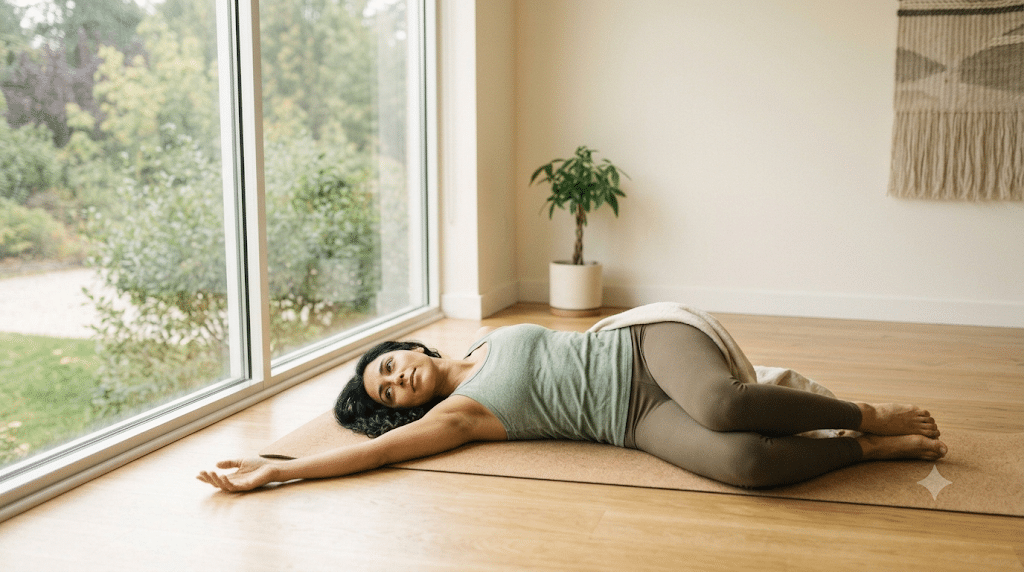
From constructive rest, let both knees fall gently to one side while your gaze drifts to the opposite direction, keeping both shoulders anchored to the floor. Move in and out of this twist several times rather than holding it fixed, following whatever rotation feels genuinely available that day.
A cork yoga mat makes a noticeable difference here, since the natural grip keeps your shoulders from sliding as you twist and gives your body a stable surface to release against.
Twisting movements specifically target the fascia surrounding your spine, an area that tends to store rotational stress from long hours of sitting.
Pose Five — Supported Fish Pose for the Chest
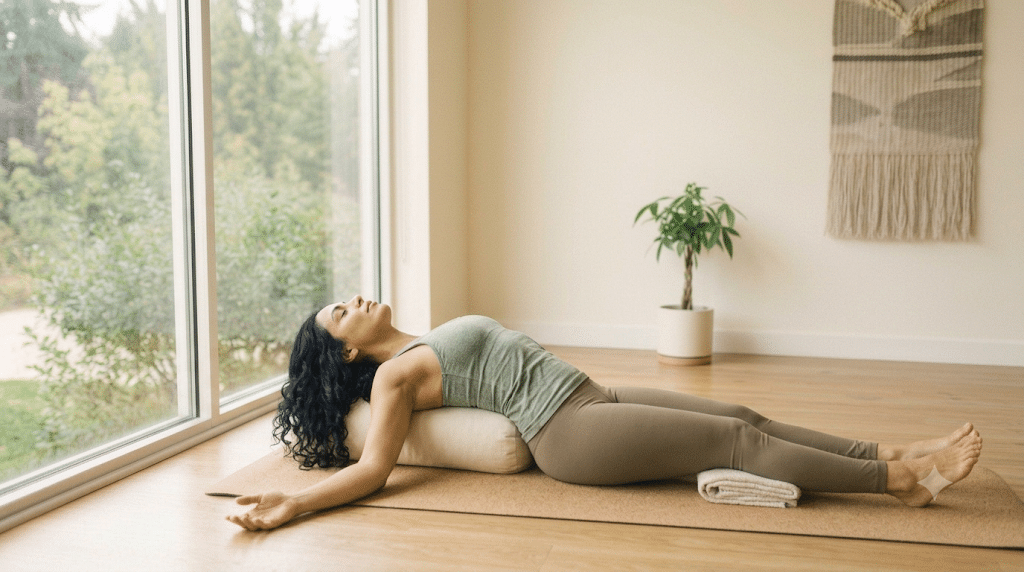
Place a bolster lengthwise beneath your spine so your chest opens gently upward, letting your arms fall open to either side. Chronic stress often collapses the chest forward, and this pose invites it to soften back open without any forcing.
I keep a bolster within arm’s reach during almost every practice, because supported backbends like this one undo hours of hunched-forward tension in a matter of minutes.
Breathe here for two full minutes, letting each exhale draw your shoulder blades a little closer to the floor.
Pose Six — Somatic Shoulder Rolls and Neck Release
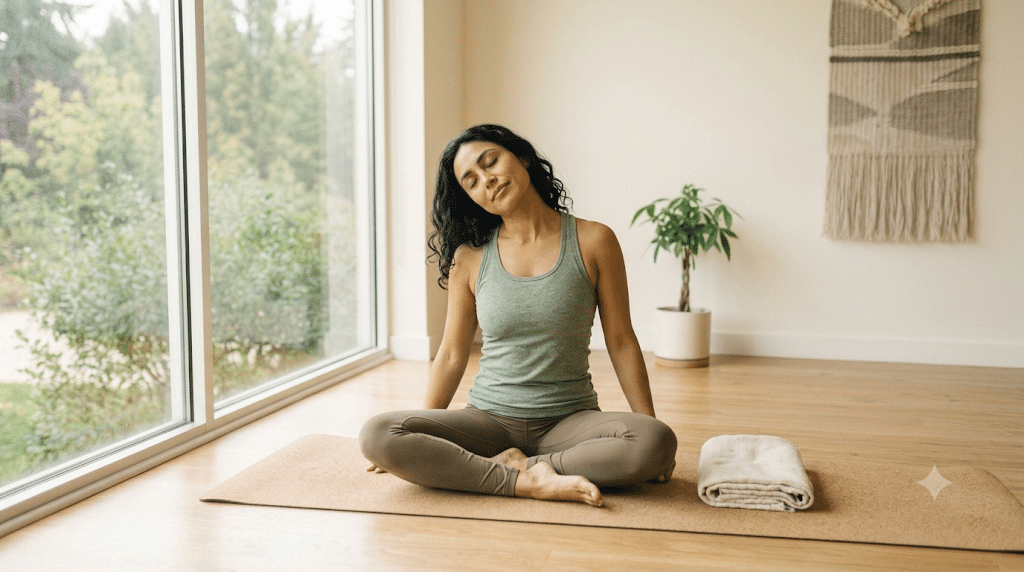
Sit comfortably and lift both shoulders slowly toward your ears, pausing at the very top before letting them fall with a long exhale. Repeat this several times, then let your head tilt gently from side to side, tracking exactly where tightness lives in your neck.
This is one of the simplest poses in the entire sequence, yet it is often the one my clients say they reach for most during a stressful workday. Slow shoulder release interrupts the habitual bracing pattern that stress creates around the neck and upper back before it has a chance to compound.
Pose Seven — Seated Forward Fold with Support
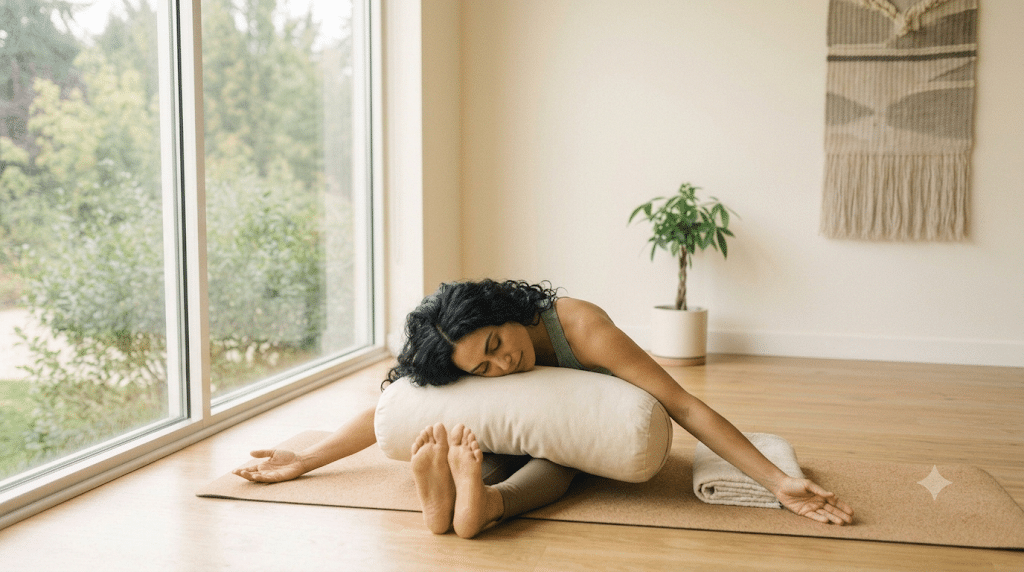
Sit with your legs extended and a bolster resting across your thighs, then fold forward slowly until your torso rests on the support. Let your arms drape loosely to either side rather than reaching for your feet.
This gentle inward fold has a naturally quieting effect on the nervous system, partly because the forward compression on the abdomen echoes the self-soothing posture we instinctively take when overwhelmed. Stay here for one to two minutes, breathing into the space between your shoulder blades.
Pose Eight — Supported Fish Pose for the Chest
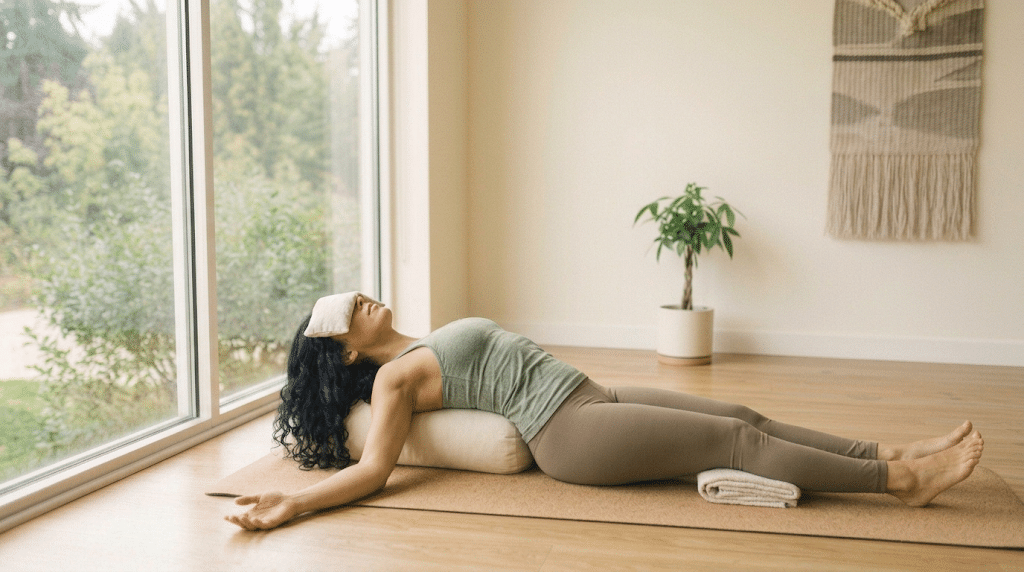
Place a bolster lengthwise beneath your spine so your chest opens gently upward, letting your arms fall open to either side. Chronic stress often collapses the chest forward, and this pose invites it to soften back open without any forcing.
Breathe here for two full minutes, letting each exhale draw your shoulder blades a little closer to the floor and your collarbones widen.
Pose Nine — Somatic Body Scan in Savasana
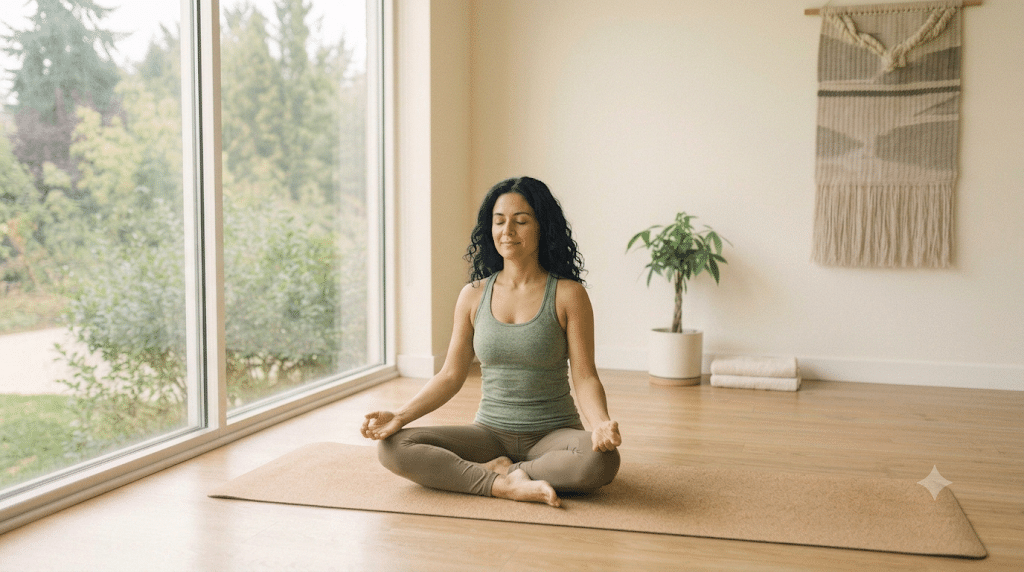
Lie flat with an eye pillow resting gently over your closed eyes, letting its soft weight signal to your nervous system that it is safe to stop scanning the room for threats. Move your attention slowly through each region of your body, pausing anywhere you notice tightness without trying to force it away.
This eye pillow has become such a consistent part of my own evening practice that my body now relaxes almost the moment I feel its weight settle.
A Five-Step Somatic Practice for Daily Stress Relief
Here is a simple sequence you can return to any time stress builds during your day.
- Sit or lie down and take three slow breaths, doing nothing else but noticing where your body makes contact with the floor.
- Move into constructive rest position, letting your spine settle heavily for two full minutes.
- Add three rounds of slow, small cat-cow movements, following the exact place your spine wants to move.
- Transition into a reclined twist on each side, moving gently rather than holding a fixed stretch.
- Finish in supported savasana with an eye pillow, staying for at least five minutes before slowly returning to sitting.
This entire sequence takes under fifteen minutes and can be repeated daily as your nervous system’s new baseline begins to shift.
Building Somatic Awareness Beyond the Mat
Stress relief through somatic yoga does not end when you roll up your mat. The same slow, interoceptive attention can be applied throughout your day, whether you are standing in line or sitting at your desk.
What would it feel like to check in with your shoulders right now, this very sentence, and notice whether they have crept upward? That small pause, repeated often enough, becomes its own form of ongoing stress relief that requires no mat at all.
Key Takeaways
→ Somatic yoga targets the nervous system directly, not just the thinking mind
→ Slow, felt-sense movement retrains the body’s stress response over time
→ Constructive rest and supported poses allow gravity to do the releasing work
→ A short five-step daily practice is enough to build lasting change
→ Awareness built on the mat can extend into everyday moments off the mat
Frequently Asked Questions
Your Body Already Knows How to Release
Somatic yoga works because it trusts the body’s own intelligence rather than overriding it with force. You do not need to be flexible or experienced to feel its effects; you only need to slow down enough to notice what is already there.
There is no need to do this perfectly. Five minutes of gentle, consistent practice will do more for your nervous system than an hour of forced effort ever could.
I would love for you to try just one of these poses today, even for a few minutes, and see how your body responds. Come back and let me know how it felt, or explore more somatic practices with me here at SomaticYogaFlow.com.
What is the difference between somatic yoga and regular yoga?
Regular yoga typically emphasizes alignment and achieving a visual shape, while somatic yoga emphasizes internal sensation and felt experience over how a pose looks. Movements in somatic yoga are often smaller and slower, guided entirely by what feels available in the body that day. Both practices offer benefits, but somatic yoga is specifically designed to retrain the nervous system’s stress response rather than build strength or flexibility.
Can somatic yoga help with anxiety as well as stress?
Yes, somatic yoga is often used for anxiety because both stress and anxiety involve an overactivated nervous system. The slow, grounding nature of somatic movement helps shift the body out of fight-or-flight and into a calmer parasympathetic state. Many people find that regular somatic practice reduces the frequency and intensity of anxious episodes over time, alongside other appropriate support.
How often should I practice somatic yoga for stress relief?
Even five to fifteen minutes daily can create noticeable changes in how your body holds tension. Consistency matters far more than duration here, since the nervous system responds best to repeated, gentle signals of safety rather than occasional long sessions. A short daily practice, like the one outlined above, tends to outperform infrequent longer ones.
Do I need any special equipment to start somatic yoga?
No special equipment is required, though a few props like a bolster, blanket, or eye pillow can make certain poses more accessible and comfortable. A yoga mat with good grip is helpful for floor-based movements and twists. Many somatic poses can also be practiced in bed or on a carpeted floor if you are just getting started.
Why does somatic yoga feel different from other relaxation techniques?
Somatic yoga feels different because it works directly with physical sensation rather than only redirecting the mind. Many relaxation techniques ask you to think your way to calm, while somatic yoga asks you to feel your way there instead. This bottom-up approach often reaches tension that purely mental techniques cannot access.