
Your body has been trying to tell you something for a long time. Maybe it speaks through tight shoulders that never fully release, through a jaw you clench without realizing it, through a chest that feels perpetually compressed — like something heavy is always sitting there. You have stretched, exercised, maybe even tried traditional yoga. And yet the tension keeps coming back, because movement alone was never the whole answer.
That experience is far more common than you might think. So many women carry stress not just in their minds but woven into the very tissue of their bodies — and conventional exercise often skips right past it. Your nervous system holds the key, and until you work with it directly, lasting relief stays just out of reach.
Somatic yoga is different. It works from the inside out, using slow, intentional movement to rewire your nervous system rather than simply stretch your muscles. As a certified somatic yoga teacher and nervous system coach, I have guided hundreds of women through this practice and watched it change everything — from sleep quality to chronic pain to emotional resilience. In this article you will learn exactly what somatic yoga for beginners looks like, why it works, and seven healing poses you can try today, even if you have never done yoga a day in your life.
Table of Contents
What Is Somatic Yoga for Beginners — and Why Is It Different?
Most fitness approaches ask your body to perform. Somatic yoga asks your body to feel. The word “somatic” comes from the Greek word soma, meaning the living body as experienced from within. This practice draws on somatic education principles — the idea that awareness itself is the tool for healing, not effort or force.
In a traditional yoga class, you might hold Warrior II and focus on alignment. In somatic yoga, you move slowly into a gentle shape and pay attention to what arises — sensation, breath changes, emotional shifts, memories held in the tissue. The practice is about internal noticing, not external performance. That shift alone changes everything.
Research published in the Journal of Traumatic Stress has found that body-based practices that incorporate interoception — the awareness of internal body signals — significantly reduce symptoms of anxiety and post-traumatic stress. Somatic yoga is built on exactly this principle. When you slow down and listen inward, your nervous system begins to feel safe enough to release what it has been holding.
Why Beginners Often Thrive in Somatic Yoga
Here is something that surprises most people: somatic yoga for beginners is often easier than starting traditional yoga. There are no complex poses to master, no flexibility requirements, no performance pressure whatsoever. The practice meets you exactly where you are — in your body, on this day, with whatever sensations are present.
Beginners also come with an advantage. They have not yet learned to override body signals in pursuit of the “right” shape. That beginner’s openness — that willingness to simply feel — is exactly what somatic yoga invites.
How Somatic Yoga Works With Your Nervous System
Your nervous system runs on a constant loop of input and response. When stress accumulates — whether from a difficult conversation, a sleepless night, or years of chronic overload — your body moves into a protective state. Muscles tighten. Breathing shallows. Digestion slows. This is your nervous system doing its job, trying to keep you safe.
The problem is that for many women, that protective state becomes the default. The nervous system never fully returns to rest. This chronic activation — sometimes called a dysregulated nervous system — is at the root of so many symptoms we tend to treat separately: anxiety, insomnia, chronic pain, hormonal imbalance, and emotional reactivity.
Somatic yoga works by sending new signals into that loop. Slow, gentle movement combined with breath awareness and internal attention activates the parasympathetic nervous system — your rest-and-digest state. Over time, the practice literally retrains your nervous system to return to calm more easily and more often.
The Role of Pandiculation in Somatic Yoga
One of the core techniques in somatic yoga is called pandiculation — a word that sounds complicated but describes something your body already knows how to do. Think of how a cat stretches first thing in the morning: it contracts, holds, then slowly releases. That is pandiculation. Unlike passive stretching, which can trigger a stretch reflex and actually increase muscle tension, pandiculation works with the brain’s motor cortex to reset muscle length at the neurological level. It is one of the reasons somatic yoga creates lasting release where other methods only bring temporary relief.
7 Gentle Somatic Yoga Poses for Beginners
These seven poses form a complete beginner’s practice. You do not need a yoga mat, special clothing, or any prior experience. All you need is a quiet space, comfortable clothes, and about twenty minutes of unhurried time.
What makes these somatic rather than traditional yoga poses is not their shape — it is how you do them. Move slowly. Pause often. Let your breath lead. Notice what you feel without trying to change it.
Pose 1: Constructive Rest
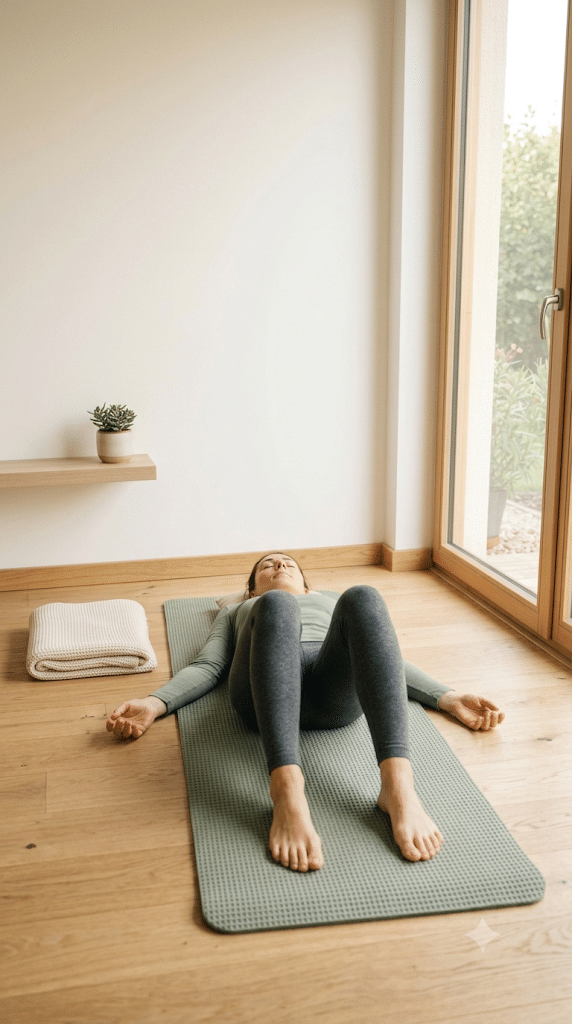
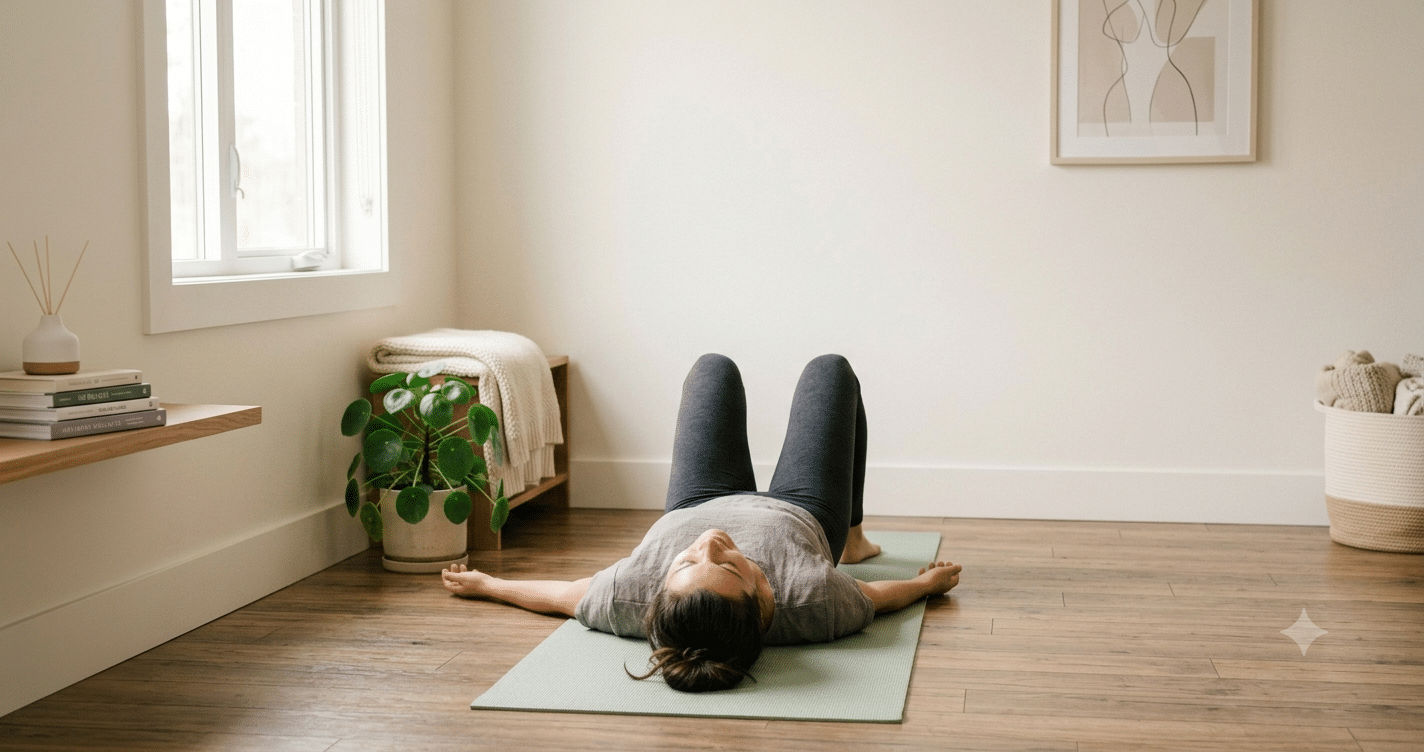
Lie on your back with your knees bent and feet flat on the floor, hip-width apart. Let your arms rest by your sides, palms facing up. Close your eyes. This is not doing nothing — this is one of the most powerful positions in somatic yoga. Your spine decompresses, your hip flexors begin to release, and your nervous system receives the unmistakable signal that you are safe and supported.
Stay here for three to five minutes, simply breathing and noticing. What do you feel? Where is there tension? Where does your body meet the floor?
Pose 2: Somatic Pelvic Tilt
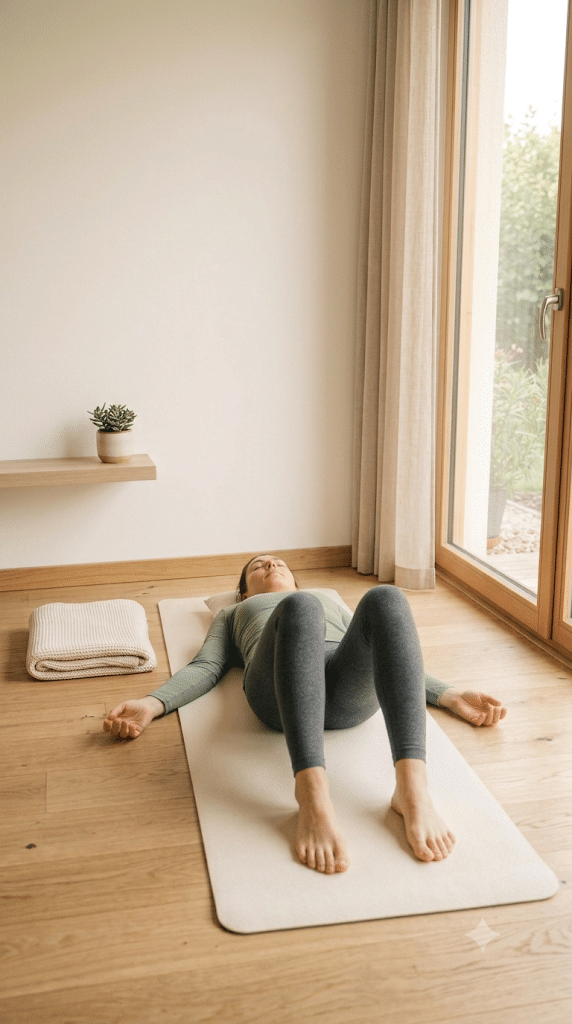
From Constructive Rest, begin to slowly rock your pelvis — inhale and gently arch your lower back away from the floor, exhale and press it softly down. This is not an exercise. You are exploring the movement, not performing it. Move at about half the speed you think you should, then half again.
This gentle rocking restores awareness and mobility to the lumbar spine and begins to release the psoas — one of the primary muscles where chronic stress accumulates.
Pose 3: Somatic Shoulder Rolls
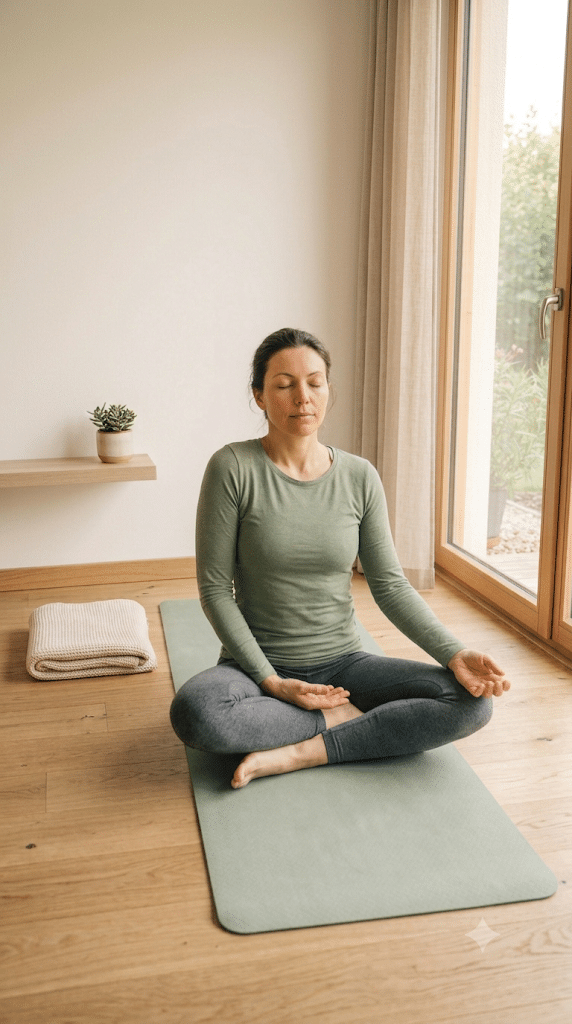
Come to a comfortable seated position — on the floor, in a chair, wherever feels supportive. Begin to slowly roll one shoulder forward, up, back, and down in a large, unhurried circle. Notice the texture of that movement. Is it smooth? Does it catch somewhere? Is one direction easier than the other?
After five slow circles forward, reverse direction. Then switch to the other shoulder. This practice reopens communication between your brain and the muscles that carry so much of your daily tension.
Pose 4: Supine Spinal Twist
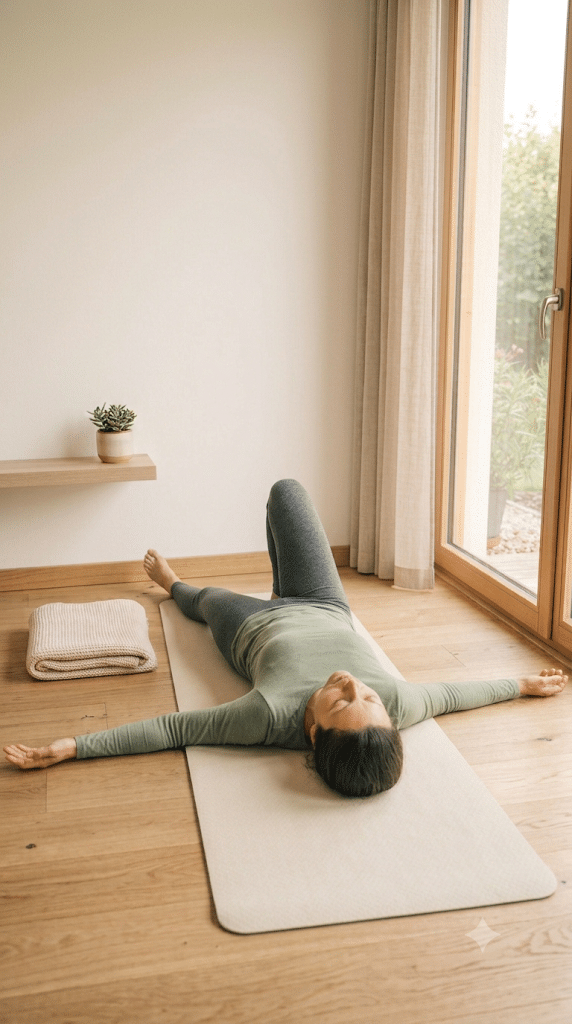
Lie on your back and draw one knee into your chest. Slowly, on an exhale, let that knee fall across your body toward the floor on the opposite side while your arms open wide. Stay here and breathe. Let gravity do the work — you are not forcing anything.
After five to eight breaths, very slowly draw the knee back to center before switching sides. That slowness on the return is part of the somatic practice — your nervous system learns just as much from how you come out of a shape as how you go in.
Pose 5: Child’s Pose With Breath Awareness
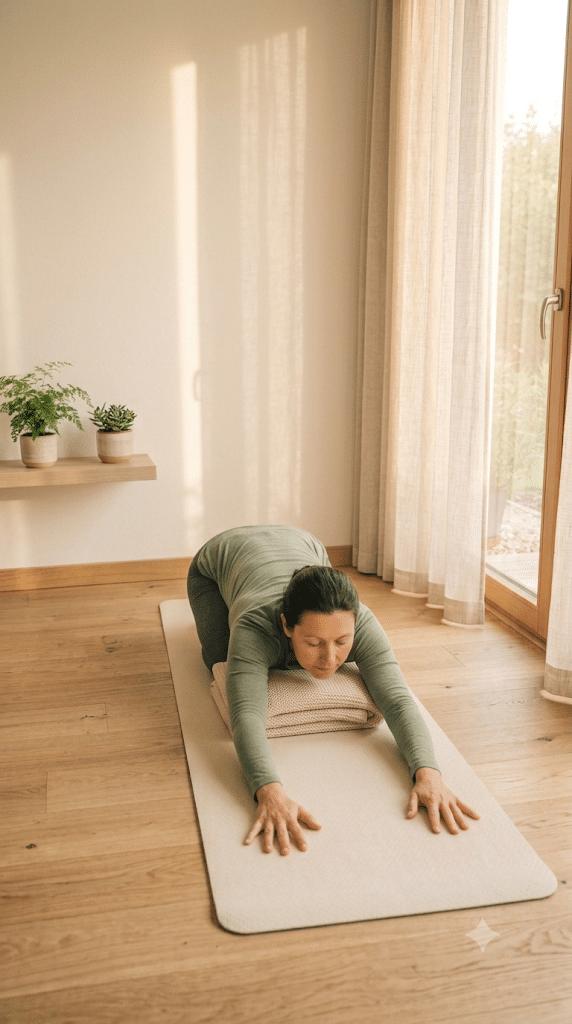
Come to hands and knees, then sink your hips back toward your heels, reaching your arms forward or resting them by your sides. In somatic yoga, Child’s Pose is not a resting pose you rush through — it is an active inquiry. As you breathe, notice how your ribcage expands into your back body. Notice the weight of your hips. Notice any emotion that surfaces in this curled, held position.
For many women, this shape touches something tender. That is welcome here. You do not need to do anything with whatever arises — simply let it be present.
Pose 6: Somatic Standing Body Scan
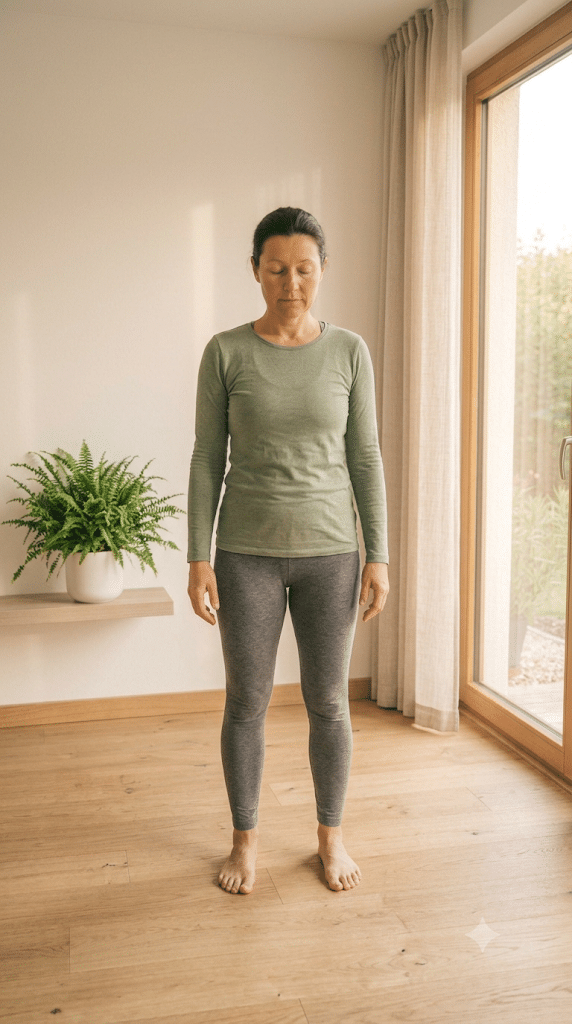
Stand with your feet hip-width apart, arms relaxed at your sides. Close your eyes if that feels comfortable. Begin a slow internal scan from the soles of your feet upward — through your calves, knees, thighs, pelvis, belly, chest, shoulders, neck, face. You are not trying to relax anything. You are simply noticing what is present. What do you feel? Where does your attention want to linger?
This practice builds interoceptive awareness — the ability to sense your body from the inside — which is, according to neuroscientist Antonio Damasio’s research on embodied cognition, foundational to emotional regulation and decision-making.
Pose 7: Legs Up the Wall
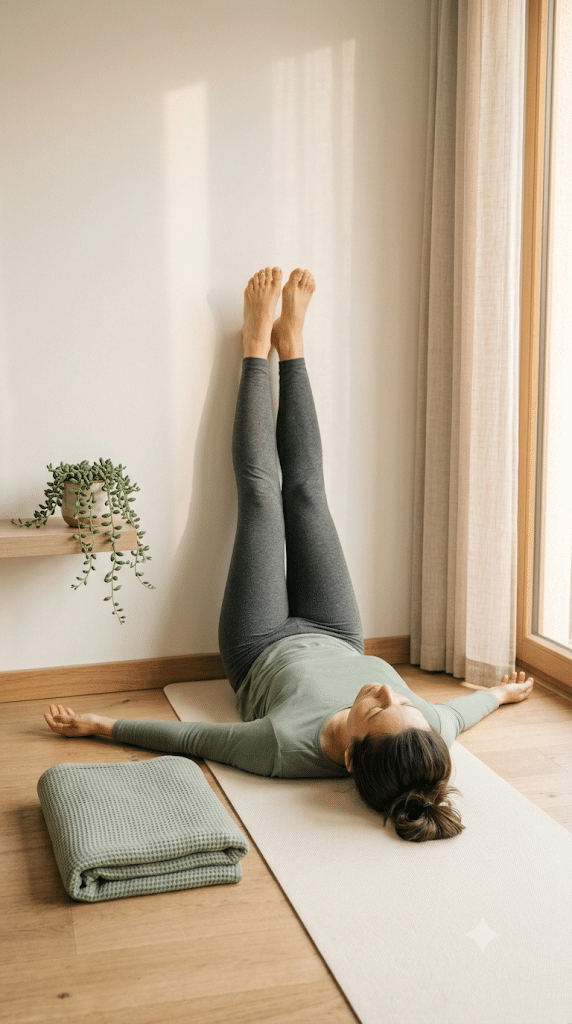
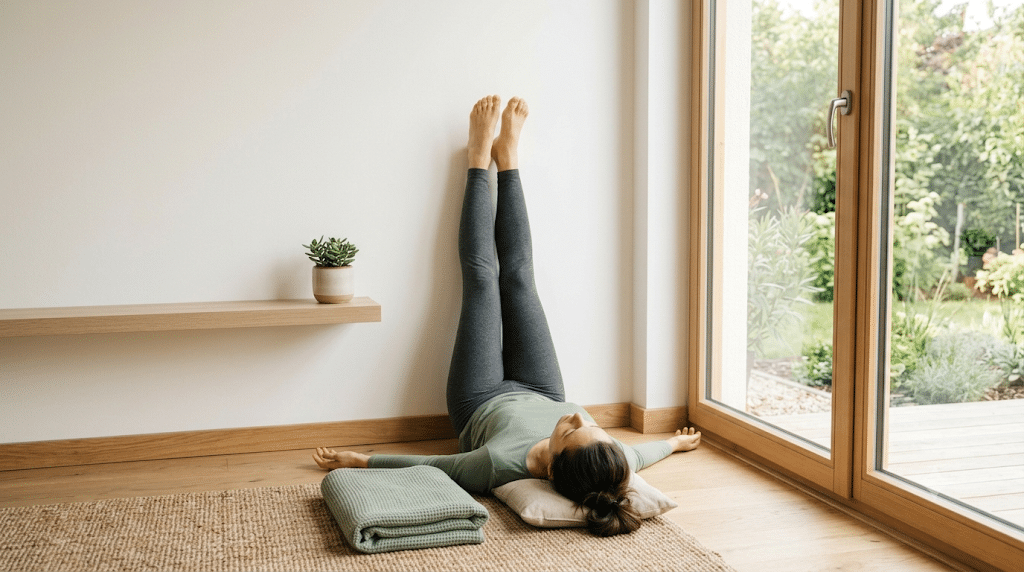
Find a clear wall space and lie on your back, swinging your legs up so they rest against the wall. Your hips can be as close to the wall as is comfortable. Let your arms rest open at your sides, palms up. Close your eyes and stay here for five to ten minutes.
This gentle inversion reverses blood flow, activates the parasympathetic nervous system, and sends a deep physiological message of safety to your entire system. It is one of the most accessible and profoundly restorative poses in any somatic practice.
💚 Sofia’s Tip: If Legs Up the Wall feels intense on your hamstrings, simply move a few inches away from the wall so your legs can rest at a more comfortable angle. The goal is ease, not stretch. Let your body guide the distance.
A Simple 5-Step Somatic Yoga Practice for Beginners
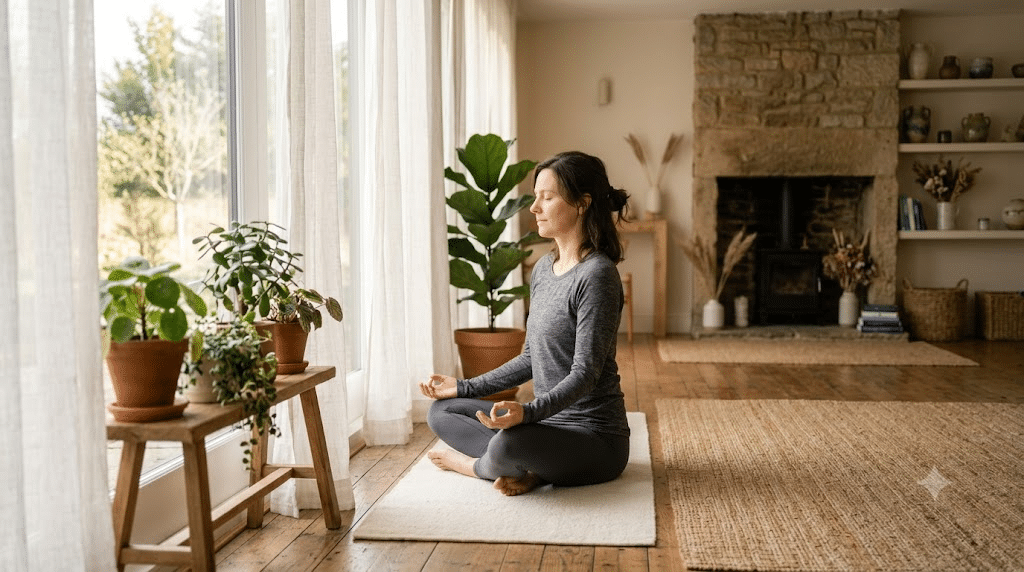
This sequence brings the seven poses together into a cohesive practice you can follow from start to finish. Give yourself twenty to thirty minutes, especially in the beginning. The slowness is not a luxury — it is the medicine.
Step 1: Begin in Constructive Rest for three to five minutes. Let your breath deepen naturally. Set a gentle intention to notice, not to achieve.
Step 2: Move into the Somatic Pelvic Tilt for two to three minutes, exploring the movement slowly in both directions. Pause completely between each repetition.
Step 3: Come to seated and spend three to four minutes on Somatic Shoulder Rolls, giving equal time to each shoulder and each direction. Move as if moving through warm water.
Step 4: Return to lying down for Supine Spinal Twist, holding each side for five to eight slow breaths. Follow with Child’s Pose With Breath Awareness for three to five minutes, using this time to turn your attention fully inward.
Step 5: Come to standing for the Somatic Body Scan, spending two to three minutes scanning slowly from feet to crown. Then lower yourself to the floor and finish with Legs Up the Wall for five to ten minutes. Let this final pose be your landing — a full integration of everything you have moved through.
Sofia’s Story: The Day My Body Finally Exhaled
I remember the first time I truly understood what somatic yoga could do — not as a teacher, but as a student. I had been practicing yoga for years, but I was doing it the way I did everything back then: efficiently, correctly, with my eye on the outcome.
One afternoon during a somatic training, my teacher asked us to lie in Constructive Rest and simply notice. Nothing else. No breath technique, no visualization. Just notice. Within about four minutes, I felt something I can only describe as a slow unraveling — a release in my chest that I had not consciously known was held. My eyes filled with tears not because anything was wrong, but because something was finally right. My nervous system had found its way home.
That moment is why I teach this work. Because the body already knows how to heal — it just needs permission, and presence, and enough stillness to remember.
What might your body be waiting to release, if you gave it the same invitation?
Common Beginner Mistakes in Somatic Yoga — and How to Avoid Them
The biggest mistake beginners make in somatic yoga is trying to do it right. They push into a stretch, hold their breath, or mentally grade their performance. Somatic yoga has no grades and no performance. The moment you find yourself efforting, that is the moment to back off and simply breathe.
The second most common mistake is moving too quickly. Speed bypasses sensation. When you move slowly — much more slowly than feels natural at first — you give your nervous system time to register what is happening, process it, and respond. That response is the healing.
Finally, many beginners skip the integration time at the end. The few minutes you spend in stillness after movement are not wasted time — they are when your nervous system consolidates the new signals you have sent it. Skipping them is like baking a cake and taking it out of the oven five minutes early.
Who Can Benefit Most From Somatic Yoga for Beginners
Somatic yoga is genuinely for everyone, but it tends to be especially powerful for women who feel disconnected from their bodies, who experience chronic muscle tension that never fully resolves, who struggle with anxiety or a nervous system that always feels “on,” or who have a trauma history that has made traditional exercise feel unsafe or overwhelming.
It is also deeply beneficial for women in perimenopause and menopause, whose nervous systems are navigating significant hormonal shifts. For older adults exploring gentle movement for the first time, somatic yoga offers a welcoming, body-led entry point — and for further senior-friendly practices.
What makes somatic yoga so universally accessible is that it requires nothing from you except willingness. No flexibility, no strength, no experience. Just the courage to slow down and listen.
Key Takeaways
→ Somatic yoga for beginners works by turning attention inward — sensation, not performance, is the practice.
→ Your nervous system holds chronic tension that stretching alone cannot resolve; somatic movement reaches deeper.
→ The seven beginner poses in this article can be practiced in twenty minutes with no equipment and no prior experience.
→ Pandiculation — contracting, holding, and slowly releasing — is more effective than passive stretching for lasting muscle relief.
→ Consistency and gentleness matter far more than perfection; even ten minutes of somatic practice creates meaningful change over time.
Conclusion
Somatic yoga for beginners is one of the most compassionate and effective ways to begin healing the relationship between your mind, body, and nervous system. You do not need to have it all together to start. You do not need to be flexible, experienced, or even certain that this will work for you. What you need is exactly what you already have: a body that is ready to be heard.
Be gentle with yourself as you begin. Some days the practice will feel profound, and other days it will simply feel like lying on the floor — and both of those are exactly right. The nervous system heals through repetition and safety, not through dramatic breakthroughs. Show up, slow down, and trust the process even when it feels quiet.
Try the five-step practice today — even just the first two poses if that is all you have time for. Notice what you feel. Notice what shifts, even slightly. That noticing is the beginning of everything. Explore more somatic yoga practices and nervous system healing tools right here on SomaticYogaFlow.com, and leave a comment below to share what comes up for you — I read every one.
FAQ
What is somatic yoga for beginners and how is it different from regular yoga?
Somatic yoga for beginners focuses on internal body awareness rather than achieving specific poses or alignment. While traditional yoga often emphasizes correct form and physical challenge, somatic yoga uses slow, gentle movement to help you sense what is happening inside your body. The goal is nervous system regulation and releasing stored tension, not flexibility or strength. Most beginners find it far more accessible than conventional yoga because there is no performance element — only presence and curiosity.
Can somatic yoga help with anxiety?
Yes — somatic yoga is one of the most evidence-supported movement practices for anxiety relief. By activating the parasympathetic nervous system through slow movement, breath awareness, and interoception, it directly interrupts the physiological stress response. Research consistently shows that body-based practices reduce cortisol levels and improve emotional regulation. Even a short daily somatic practice of ten to fifteen minutes can meaningfully reduce baseline anxiety over several weeks of consistent use.
How long does it take to see results from somatic yoga?
Many beginners notice a shift in their nervous system state after a single session — a sense of calm, reduced muscle tension, or emotional ease. Deeper structural changes in how your nervous system responds to stress typically develop over four to eight weeks of regular practice. Consistency matters far more than duration; ten minutes daily is more effective than an hour once a week. Approach the practice with patience and curiosity rather than goal-orientation for the best results.
Do I need any equipment to start somatic yoga at home?
No special equipment is required for somatic yoga. A yoga mat can add comfort but is not necessary — a carpeted floor or a folded blanket works perfectly well. Comfortable, non-restrictive clothing is helpful, and you may want a folded blanket or pillow under your head for floor-based poses. The most important ingredient is quiet, unhurried time. Even twenty minutes in a private space where you feel safe to slow down is all you need to begin.
Is somatic yoga safe for people with trauma?
Somatic yoga is widely considered one of the most trauma-sensitive movement modalities available. Because it is entirely self-paced, non-performative, and built around listening to your body rather than pushing past its signals, it rarely triggers overwhelm the way more vigorous exercise can. However, if you have a significant trauma history, working with a trauma-informed somatic yoga teacher one-on-one initially is always worth considering. Trust your own body’s signals throughout — if anything feels too intense, it is always right to pause, rest, or simply breathe.