
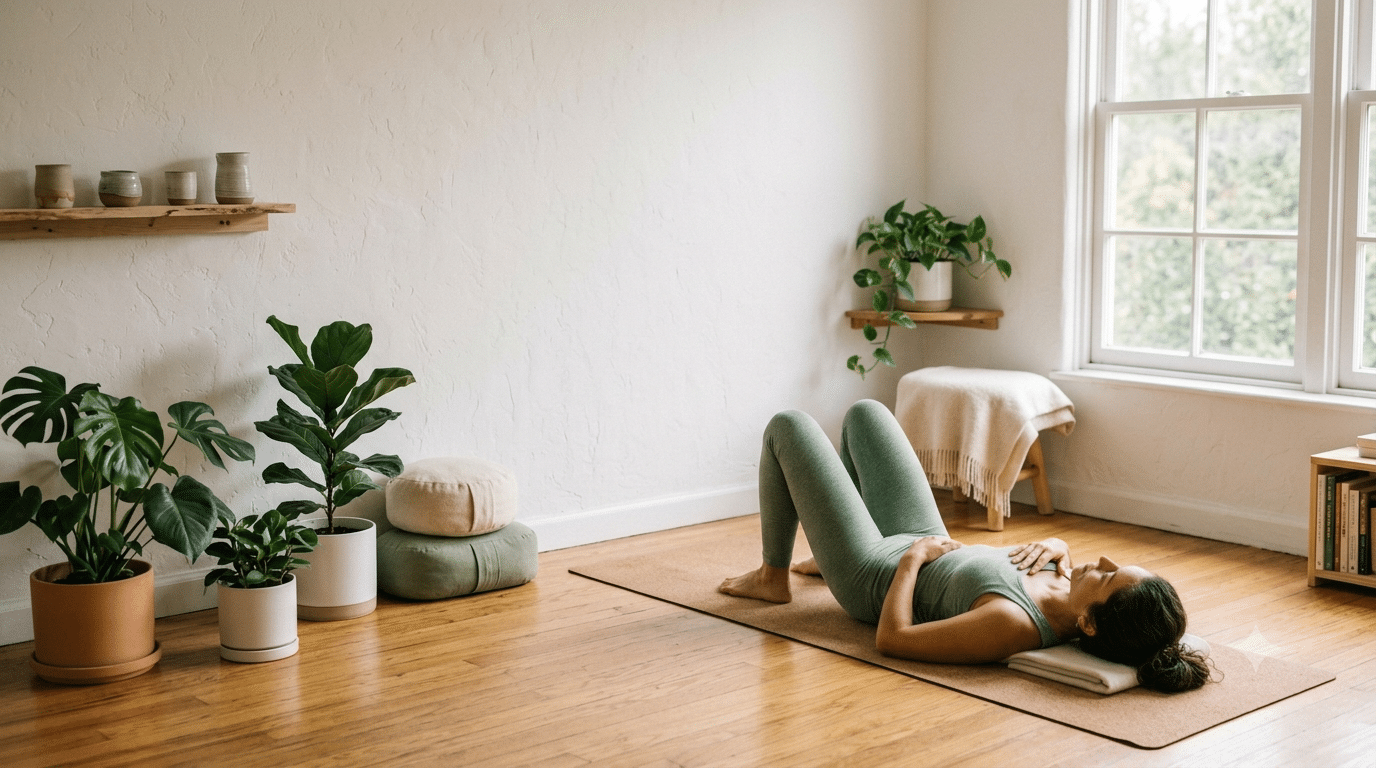
You wake up already tired. Your shoulders are braced before your feet even touch the floor. Somewhere between the endless to-do lists, the emotional labor, and the low hum of anxiety that never quite goes away, your body has started holding everything — tightly, quietly, relentlessly.
I see you. And I want you to know that what you are feeling is not weakness. It is the natural response of a nervous system that has been asked to carry too much for too long. Your body is not broken. It is simply stuck in a pattern it learned to survive — and it needs a different kind of invitation to let go.
That invitation is somatic yoga. Unlike traditional yoga, which often focuses on flexibility or fitness, somatic yoga works from the inside out. It uses slow, intentional movement to access the body’s own nervous system — to release tension that stretches alone cannot reach. The science behind it is genuinely remarkable, and the results are felt not just in the body but in every corner of your life.
In this article, I am going to walk you through ten proven somatic yoga benefits — what they are, why they happen, and how you can begin experiencing them for yourself.
Table of Contents
Somatic Yoga Benefits Begin in the Nervous System
Most people come to somatic yoga because something hurts — their back, their anxiety, their sleep, their sense of self. What they discover is that all of those things are connected, and they are all rooted in the state of the nervous system.
Somatic yoga works directly with the autonomic nervous system, which governs your stress response. Through slow, mindful movement paired with breath awareness and interoception — the ability to sense what is happening inside your body — somatic yoga helps shift you out of the chronic fight-or-flight state that so many of us live in without even realizing it.
A 2018 study published in Frontiers in Human Neuroscience found that mind-body practices that combine movement with internal awareness significantly reduce cortisol levels and activate the parasympathetic nervous system — what we call the rest-and-digest state. This shift is not just relaxing. It is healing. And it is the foundation from which every other somatic yoga benefit flows.
Why the Body Holds What the Mind Cannot Process
You may have heard the phrase “the body keeps the score” — and it is not just a book title. It is a biological reality. When we experience stress, fear, or overwhelm, our nervous system encodes that experience in our tissues, our posture, our breathing patterns. Traditional talk therapy addresses the mind. Somatic yoga addresses the body — and when both work together, something profound becomes possible.
💚 Sofia’s Tip: Before you begin any somatic yoga practice, place one hand on your chest and one on your belly. Take three slow breaths and simply notice — not change — what you feel. This single act of internal awareness primes your nervous system for deeper release than any stretch ever could.
Somatic Yoga Benefits Chronic Stress and Cortisol Levels
Chronic stress is not a personality flaw. It is a physiological state — one that most modern women know far too intimately. When cortisol stays elevated day after day, it disrupts sleep, weakens immunity, increases inflammation, and contributes to anxiety and depression. The body was never designed to run on high alert indefinitely.
Somatic yoga is one of the most effective tools I know for interrupting this cycle. Through practices like pandiculation — the slow, voluntary contraction and release of muscles — and breath-synchronized movement, somatic yoga sends direct signals to the brain that it is safe to down-regulate. The effect is cumulative. The more you practice, the more quickly your nervous system learns to return to calm.
The Pandiculation Effect
Pandiculation is perhaps the most important concept in somatic yoga, and it is something I wish every woman dealing with burnout understood. It works by deliberately contracting a tense muscle, moving slowly through that contraction, and then releasing with complete intention. This resets the muscle’s resting length and, crucially, updates the brain’s map of the body. The result is a release that is neurological — not just muscular.
I often tell my students: the gentler you go, the deeper you reach. Speed and force are the language of the stress response. Slowness is the language of safety.
Somatic Yoga Benefits Anxiety by Regulating the Vagus Nerve
The vagus nerve is the longest nerve in the body, running from the brainstem all the way down through the heart, lungs, and digestive system. It is the primary pathway of the parasympathetic nervous system — and it is the key to why somatic yoga works so powerfully for anxiety.
When we are anxious, vagal tone is low. The heart races, the breath becomes shallow, the gut tightens. Somatic yoga practices — particularly slow diaphragmatic breathing, humming, and gentle spinal movement — directly stimulate the vagus nerve and increase vagal tone. A 2021 review in Neuroscience and Biobehavioral Reviews confirmed that vagus nerve stimulation through breath-based practices produces measurable reductions in anxiety symptoms.
What does this feel like in practice? It feels like your chest finally softening. Like the knot in your stomach loosening without you having to do anything dramatic to make it happen.
Somatic Yoga and the Polyvagal Ladder
Stephen Porges’ Polyvagal Theory gives us a beautiful framework for understanding why somatic yoga helps anxiety. Most anxious women are cycling between the sympathetic state — activated, hypervigilant — and the dorsal vagal state — shut down, disconnected, exhausted. Somatic yoga helps you climb what practitioners call the “polyvagal ladder” back into the ventral vagal state, which is the state of connection, safety, and calm aliveness.
This is not a metaphor. It is neuroscience. And it is why so many women tell me that somatic yoga feels different from anything else they have tried.
I always begin my practice on a cork yoga mat — the natural texture gives me an instant sense of grounding that synthetic mats simply cannot replicate.
Somatic Yoga Benefits Sleep Quality Deeply and Consistently
Sleep is where your body repairs, consolidates memory, and processes emotion. And it is one of the first things to suffer when your nervous system is chronically activated. If you lie down at night and your mind races, your muscles clench, or you startle awake repeatedly — your nervous system does not know it is safe to rest.
Somatic yoga before bed teaches your body a different truth. Through practices like constructive rest, body scan awareness, and gentle floor-based movement, somatic yoga helps the nervous system transition out of the alert state and into the receptive, restful state that deep sleep requires. Many of my students report that just fifteen minutes of somatic practice before bed changes the quality of their sleep within the first week.
If you have never tried an eye pillow during a body scan, I genuinely encourage you to — the gentle weight signals your nervous system that it is safe to fully let go.
Why Somatic Yoga Works When Sleep Hygiene Alone Does Not
Sleep hygiene advice — no screens, cool room, consistent bedtime — addresses behavior. Somatic yoga addresses biology. You can follow every sleep rule perfectly and still lie awake because your nervous system is stuck in activation. Somatic yoga works at the level where sleep actually lives: in the body’s felt sense of safety.
Somatic Yoga Benefits the Body by Releasing Chronic Muscle Tension
Have you ever noticed that no matter how many massages you get, the same spots keep getting tight? The upper traps. The jaw. The psoas. The breath. These are not random — they are the body’s habitual patterns of bracing, built up over years of stress, trauma, or overwork.
Somatic yoga does not just release tension in the moment. It interrupts the neuromuscular habit that keeps recreating that tension. Through slow, conscious movement and targeted pandiculation sequences, you literally retrain the motor cortex to stop sending the contraction signal to those muscles. The release, when it comes, is profound — and it lasts.
The Role of the Psoas in Stress and Tension
The psoas muscle — often called the “muscle of the soul” — connects your lumbar spine to your femur and is one of the primary muscles involved in the fear response. When you are chronically stressed, the psoas chronically contracts. This pulls the lower back forward, compresses the spine, and contributes to the tight, guarded posture so many anxious women carry.
Somatic yoga sequences that target the psoas with slow, exploratory movement can produce releases that feel almost emotional in their intensity. Women often tell me they felt like they exhaled something they had been holding for years.
Somatic Yoga Benefits Chronic Pain Through Neurological Reset
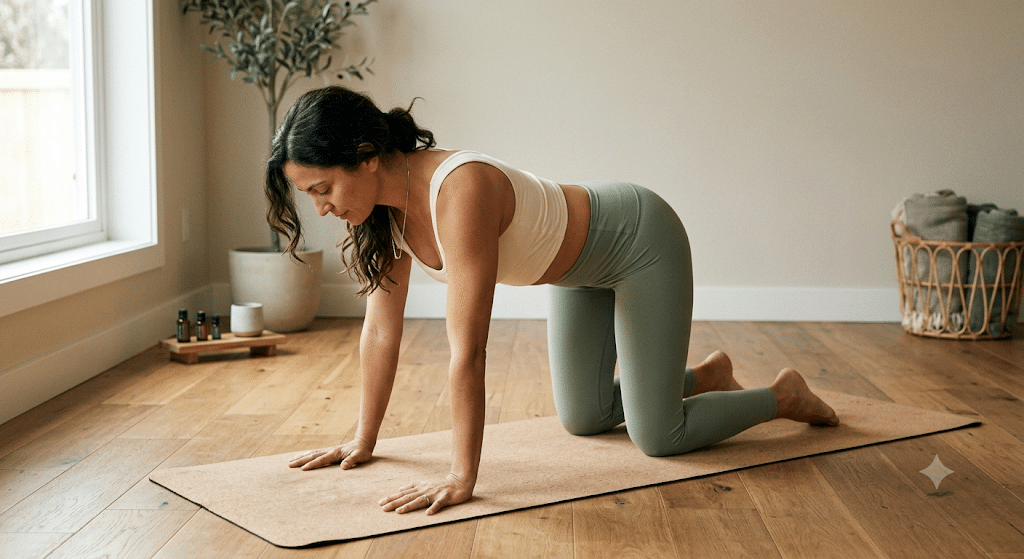
Chronic pain is complex, and I want to speak to it carefully. A significant portion of chronic pain — particularly the kind that persists beyond initial injury — is maintained by the nervous system. The brain has learned to generate a pain signal as a protective response, even when the original tissue damage has healed.
A landmark study in Pain journal found that somatic movement practices reduce chronic pain not primarily by changing the body’s structure, but by changing the brain’s interpretation of sensation. This is why somatic yoga so often helps where physical therapy, stretching, and medication alone have not.
Placing a yoga bolster beneath your knees completely changes the experience — your lower back releases in a way that feels almost effortless.
[AMAZON LINK: yoga bolster]
Pain, Perception, and the Somatic Approach
In somatic yoga, we approach pain with curiosity rather than avoidance. We move toward the edges of sensation slowly and gently, learning to distinguish between the discomfort of tension and the signal of genuine harm. This process — called somatic differentiation — gradually expands the window of tolerance and reduces the nervous system’s hair-trigger response to sensation.
What does that mean for real life? It means pain begins to lose its grip — not because you are ignoring it, but because your nervous system is finally learning that movement is safe.
Somatic Yoga Benefits Emotional Regulation and Resilience
Here is something I believe deeply: we cannot think our way out of feelings that live in the body. We have to move through them — literally. Emotions are physical phenomena. Fear contracts the chest. Grief collapses the shoulders. Anger clenches the jaw and fists. When we learn to work with the body, we gain access to emotional material that the mind alone cannot touch.
Somatic yoga gives us the tools to do this safely. Through slow movement, breath, and body awareness, we learn to feel our feelings without being overwhelmed by them — a skill that researchers call the window of tolerance. Over time, this practice builds genuine emotional resilience. Not the kind that means you never feel anything. The kind that means you can feel everything and still stay rooted in yourself.
Sofia’s Personal Story
I came to somatic yoga after a period in my mid-thirties that I can only describe as a slow collapse. I was teaching yoga, I was meditating, I was doing everything “right” — and I was still waking up at 3 a.m. in a cold sweat, still snapping at the people I loved, still carrying a heaviness I could not name. A colleague introduced me to somatic approaches, and the first time I did a simple pandiculation sequence on my floor, I cried. Not from pain. From relief. My body had been waiting for permission to let go, and for the first time, I gave it that permission. That was the beginning of everything that became SomaticYogaFlow.com.
Somatic Yoga Benefits Body Awareness and Interoception
Interoception — the ability to sense your body’s internal signals — is one of the most important and underappreciated skills a human being can develop. Research from the University of California has linked strong interoceptive awareness to better emotional regulation, lower anxiety, improved decision-making, and even greater empathy.
Somatic yoga is essentially interoception training. Every practice asks you to slow down, tune inward, and listen to the subtle language of sensation that your body is constantly speaking. Over time, this builds a profound sense of embodied self-awareness — a felt sense of being at home in your own skin.
Reconnecting After Dissociation and Trauma
For women who have experienced trauma, dissociation — the experience of feeling disconnected from the body — is often a coping strategy that once served a purpose. Somatic yoga offers a gentle, non-threatening pathway back into the body. The emphasis on slow movement, choice, and self-compassion creates a sense of safety that makes reconnection possible at whatever pace the nervous system needs.
This is not therapy. But for many women, it is a powerful companion to therapeutic work.
Somatic Yoga Benefits Posture and Structural Balance
Poor posture is rarely a discipline problem. It is almost always a nervous system problem. The way we hold our bodies in space — the forward head, the collapsed chest, the braced shoulders — reflects our habitual stress state. Trying to correct posture through willpower or external cues alone is exhausting and ultimately ineffective, because the pattern lives in the nervous system, not in the muscles.
Somatic yoga addresses posture at its root. Through gentle, exploratory movement sequences — particularly those targeting the back extensors, the neck, and the breathing muscles — somatic yoga helps the body rediscover its natural upright alignment from the inside. Students are often astonished to find that after a somatic practice, they are taller without trying.
What would it feel like to carry yourself with ease — not because you are holding yourself up, but because your nervous system finally feels safe enough to let your spine do what it was designed to do?
Somatic Yoga Benefits Connection — to Yourself and Others
The final benefit on this list is perhaps the most quietly profound. When we are chronically stressed, we are not fully present — not to our own experience, not to the people we love, not to the simple pleasure of being alive in a body. Somatic yoga brings us back to the present moment, not through forced mindfulness, but through the compelling reality of felt experience.
Women who practice somatic yoga consistently report feeling more connected — to themselves, to their bodies, to their relationships, to their sense of purpose. This is not a side effect. It is the natural result of a nervous system that is no longer in survival mode. When safety is restored in the body, presence becomes possible. And presence is where life actually happens.
A 10-Step Somatic Yoga Practice to Begin Today
- Come to lie on your back with your knees bent and feet flat on the floor. Take three slow breaths and simply notice where your body makes contact with the ground beneath you.
- On your next inhale, gently arch your lower back — just a small movement, no more than you can do with ease. Pause at the top of the arch for two counts.
- On the exhale, slowly release the arch back to neutral. Move with complete intention, as though you are teaching your spine what “release” feels like.
- Repeat this arch-and-release six times, each time moving a little more slowly and with a little more internal awareness. Notice how the quality of the release changes as you slow down.
- On the seventh repetition, contract the arch, and then let the release happen even more gradually — taking a full four-count exhale to return to neutral. Feel the back muscles soften layer by layer.
- Now bring your attention to your shoulders. On an inhale, gently draw them up toward your ears — a small, deliberate shrug. Notice every sensation.
- On the exhale, release them with the same slow, intentional quality. Repeat six times. Let yourself be surprised by how much tension was being held there without your awareness.
- Bring both knees to your chest and rock gently side to side, just a few centimeters in each direction. Let the movement come from curiosity, not effort.
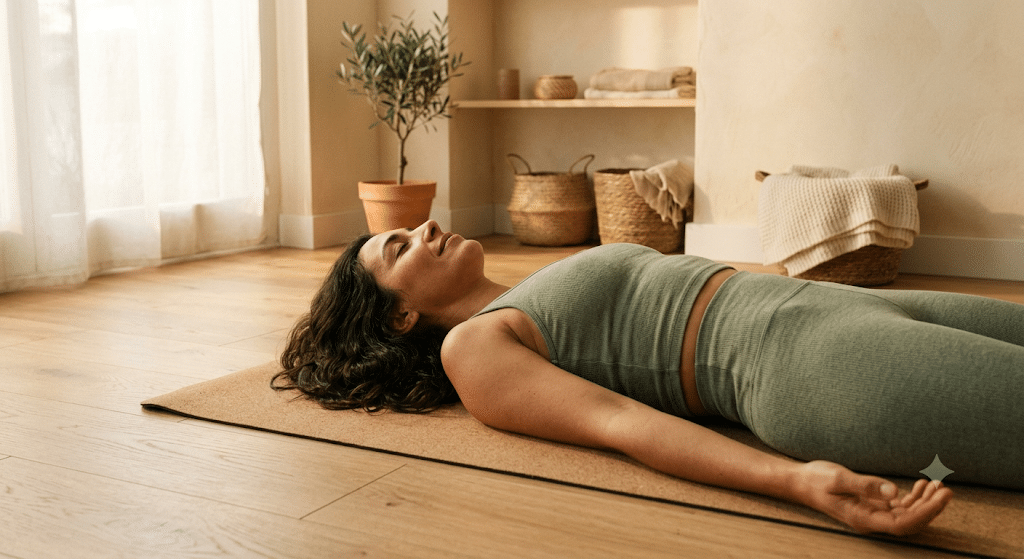
- Extend both legs long and rest with your palms facing upward. Take ten slow breaths, and with each exhale, allow your body to become a little heavier, a little more surrendered to the floor.
- Before you rise, take a moment to notice the overall quality of sensation in your body. Acknowledge — gently and without judgment — that something has shifted.
Key Takeaways
→ Somatic yoga works with the nervous system, not just the muscles — making its effects deeper and longer-lasting than conventional stretching.
→ Chronic stress, anxiety, and poor sleep are all rooted in nervous system dysregulation — and somatic yoga addresses all three at the source.
→ Pandiculation — the slow contract-and-release technique central to somatic yoga — resets neuromuscular patterns rather than simply stretching them.
→ Regular somatic yoga practice builds interoceptive awareness, emotional resilience, and a genuine felt sense of safety in the body.
→ You do not need to practice for hours to experience somatic yoga benefits — even ten to fifteen minutes of slow, intentional movement creates measurable nervous system shifts.
Somatic yoga benefits are not reserved for the flexible, the experienced, or the unburdened. They are available to you exactly as you are — tired, tense, skeptical, hopeful, or somewhere in between. Every body has the capacity to shift from survival to safety, from bracing to ease, from disconnection to presence.
You do not need to do this perfectly. Perfection is a stress response in disguise. What you need is consistency, gentleness, and the willingness to show up for yourself again and again — in five minutes or fifteen, on your bedroom floor or your yoga mat, with or without the perfect conditions.
Start with the ten-step practice above. Do it tonight, or tomorrow morning, or right now. Notice what you notice. And then come back again tomorrow — not because you are broken and need fixing, but because you deserve to live in a body that feels like home.
I would love to know what you experience. Share your thoughts in the comments below, and explore more somatic yoga practices waiting for you at SomaticYogaFlow.com.
Frequently Asked Questions
What is somatic yoga and how is it different from regular yoga?
Somatic yoga is a movement practice that emphasizes internal body awareness — or interoception — rather than achieving external shapes or postures. Where traditional yoga often measures progress by how far you can stretch or how a pose looks, somatic yoga measures progress by what you can feel and release from the inside. It draws on somatic education principles developed by Thomas Hanna and others, using techniques like pandiculation to retrain the nervous system and release chronic muscular tension at its neurological root.
How long does it take to feel somatic yoga benefits?
Many people notice a shift after their very first session — a sense of quiet, ease, or physical release that feels different from conventional exercise. For deeper and more lasting benefits, particularly around anxiety, chronic pain, and sleep, most practitioners report meaningful changes within two to four weeks of consistent practice. The key is regularity over intensity: ten to fifteen minutes daily tends to produce stronger results than one long session per week.
Can somatic yoga help with trauma?
Somatic yoga can be a valuable support for trauma healing, particularly because it addresses the body-held aspects of traumatic experience that talk therapy alone does not always reach. The slow, choice-based, non-forceful nature of somatic yoga creates a sense of physical safety that makes gentle reconnection with the body possible. However, for anyone working through significant trauma, somatic yoga is best used as a complement to professional therapeutic support rather than a replacement for it.
Is somatic yoga suitable for beginners with no yoga experience?
Somatic yoga is genuinely one of the most accessible movement practices available, and in many ways it is better suited to beginners than traditional yoga. There are no complex postures to master, no flexibility prerequisites, and no performance element. Most somatic yoga practices take place lying on the floor or seated, using only the smallest, most comfortable movements. If you can lie on a mat and breathe, you can practice somatic yoga.
How often should I practice somatic yoga to get the benefits?
Daily practice — even in short sessions of ten to fifteen minutes — produces the most consistent and cumulative nervous system benefits. The regularity of the signal matters more than the duration of any single session. If daily feels unrealistic, three to four sessions per week is a meaningful starting point. Over time, many practitioners find that somatic yoga becomes something they crave rather than something they schedule — because their body learns, viscerally, how good it feels to let go.