You have been showing up to your mat for months — maybe years. You move through the sequences, you breathe when the instructor tells you to breathe, and yet something still feels locked. The tension in your shoulders returns by Tuesday. The anxiety that loosened during class is back by evening. You are doing everything right, and still your body feels like it is holding a secret you cannot quite reach.
I want you to know that this is not a failure of effort or commitment. Many women come to me after years of traditional yoga practice feeling exactly this way — present on the mat, but somehow unreached inside. What they were missing was not more yoga. It was a different kind of listening.
Somatic yoga offers something that conventional yoga, for all its beauty, was not originally designed to deliver: a direct conversation with your nervous system. Where traditional yoga moves the body, somatic yoga invites the body to speak.
In this article, I will walk you through seven meaningful differences between somatic yoga and traditional yoga, so you can understand which approach your body may be calling for right now.
Table of Contents
Somatic Yoga vs Yoga: What Each Practice Is Actually Doing
Before we explore the differences, it helps to understand what each practice is fundamentally designed to achieve. Traditional yoga — whether Hatha, Vinyasa, Ashtanga, or Yin — originates from ancient Indian philosophy and aims to unite body, mind, and spirit through physical postures, breathwork, and meditation. It is a profound system, and millions of people have found real healing through it.
Somatic yoga, by contrast, draws from somatic therapy, a field pioneered by figures like Thomas Hanna and Peter Levine, whose work on trauma and the body has reshaped how we understand healing. The word somatic comes from the Greek soma, meaning the living body as experienced from within. Somatic yoga is less about what the pose looks like and more about what you feel as you move through it. The practice is internal, slow, and deeply attentive.
Both paths lead toward wellbeing. But they take meaningfully different routes.
The First Difference: External Shape vs Internal Sensation
In a traditional yoga class, a large part of the focus — however subtly — is on achieving a recognizable shape. Warrior II has a particular alignment. Downward Dog has a target form. Instructors cue you toward that form, and over time you learn to assess your practice by how close your body comes to the ideal expression of each pose.
Somatic yoga gently dismantles this framework. When I guide a student through a somatic movement, I am not asking her to reach for a shape. I am asking her to notice what she feels as she begins to move, and to follow that sensation wherever it leads. The body becomes the teacher, not the destination.
This shift is quietly radical. Many women who have spent years performing yoga — doing it correctly, doing it consistently — find that somatic yoga is the first time they have actually been in their body rather than working on it.
The Second Difference: Speed and the Value of Slowness
Traditional yoga classes, even gentle ones, maintain a certain pace. There are sequences to move through, postures to hold, transitions to navigate. Even in a Yin class, where poses are held for several minutes, the instruction is generally about arrival — getting into the pose and staying there.
Somatic yoga moves at the speed of sensation, which is often much slower than we expect. A somatic movement might involve lifting one arm just a few inches, pausing, noticing the quality of that movement, and then slowly lowering it. The whole thing might take three minutes. From the outside, it looks like almost nothing is happening.
Inside, however, the nervous system is doing profound work. Research published in the journal Frontiers in Psychology has shown that slow, mindful movement activates the parasympathetic nervous system — the branch responsible for rest, repair, and a sense of safety. This is the neurological foundation of real, lasting calm.
💚 Sofia’s Tip: If you find somatic movements frustratingly slow at first, that resistance is actually information. Many of us have learned to use speed as a way of staying just above the surface of our feelings. Slowing down is not laziness — it is the practice.
The Third Difference: Nervous System Regulation as the Primary Goal
Traditional yoga carries many goals — flexibility, strength, mental clarity, spiritual development. Nervous system regulation is often a welcome side effect, but it is rarely the explicit, central aim of the practice.
In somatic yoga, nervous system regulation is the entire point. Every movement, every breath cue, every moment of stillness is chosen with one question in mind: does this help the nervous system feel safe?
This matters enormously for women dealing with anxiety, burnout, chronic stress, or trauma. When the nervous system is stuck in a pattern of hyperarousal or shutdown — what Peter Levine calls “incomplete stress responses” — the body cannot fully release tension no matter how many downward dogs you do. Somatic yoga works at the level where those patterns actually live.
What does that feel like in practice? Often, it feels like a quiet exhale that comes from somewhere very deep. Like something you did not know you were holding finally lets go.
The Fourth Difference: How Each Practice Handles Trauma
This is perhaps the most important distinction, and one I feel strongly about sharing clearly. Traditional yoga, practiced without trauma-informed modification, can sometimes retraumatize sensitive nervous systems. Certain poses — deep backbends, intense hip openers, even the instruction to “surrender” — can activate stored trauma responses in the body without the practitioner or instructor realizing what is happening.
I remember a student — I will call her Ana — who had practiced yoga for six years and consistently felt a wave of inexplicable panic during Savasana. She had learned to simply breathe through it, assuming it was her anxiety. When she came to somatic yoga, we discovered that her nervous system had never felt safe enough to fully rest. The practice gave her the tools to work with that response gently, at her own pace, without pushing through it.
Somatic yoga is inherently trauma-informed. It prioritizes choice, autonomy, and the ability to stop or modify at any moment. It teaches practitioners to recognize when the nervous system is moving toward overwhelm and how to titrate — a term from somatic therapy meaning to work with trauma in small, manageable doses — so that healing happens without retraumatization.
The Fifth Difference: The Role of the Breath
Both practices use breathwork as a central tool, but the relationship to breath is quite different. In traditional yoga, breath is often prescribed — inhale to rise, exhale to fold, three-part breath, alternate nostril breathing. These are powerful techniques, and they work.
In somatic yoga, breath is observed before it is directed. Sofia often begins a session by simply inviting students to notice their natural breath — not to change it, not to deepen it, just to witness it. This act of nonjudgmental observation is itself deeply regulating. When we stop fighting our breath and simply acknowledge where it is, the body often begins to breathe more fully on its own.
Have you ever noticed how your breath changes the moment someone asks you to “breathe deeply”? Often it becomes effortful and self-conscious. Somatic yoga trusts the body’s own intelligence to find its rhythm when given permission to do so.
I practice on a cork yoga mat for both my somatic and traditional sessions — the natural texture and slight warmth underfoot help me feel immediately more grounded from the first moment I step on it.
The Sixth Difference: What You Do with Discomfort
Traditional yoga has a long-standing relationship with discomfort as growth. “Breathe into the stretch.” “Find your edge.” “Stay present with what arises.” These are genuine invitations toward expansion, and there is real wisdom in learning to be with difficulty.
Somatic yoga holds a different view of discomfort. Rather than breathing through sensation, somatic practice asks you to get curious about it. Where exactly does it live? Does it have a shape or a temperature? What happens to it when you bring your awareness there? What does your body want to do in response?
This is not about avoiding challenge — it is about meeting the body’s signals with intelligence rather than willpower. A 2018 study from Harvard Medical School found that interoceptive awareness — the ability to sense internal body signals — is significantly linked to emotional regulation and reduced anxiety symptoms. Somatic yoga builds this capacity directly.
When we learn to listen to discomfort as information rather than something to overcome, we stop overriding the body’s wisdom. And that, for many women, is where genuine healing begins.
The Seventh Difference: Who Each Practice Serves Best
This is not a competition. Traditional yoga is a profound and complete system that has changed countless lives, including my own. I practiced Ashtanga for a decade before I found somatic work, and I carry those years with deep gratitude.
What I have found, in working with hundreds of women, is that somatic yoga tends to reach the ones who feel like yoga has not quite reached them yet. The women whose bodies are braced, whose nervous systems are running on high alert, who feel like they are performing relaxation rather than experiencing it. The women for whom pushing harder has never led to softening.
Could somatic yoga be what your body has been asking for? That question is worth sitting with, especially if you have found yourself going through the motions of a wellness practice without feeling genuinely well.
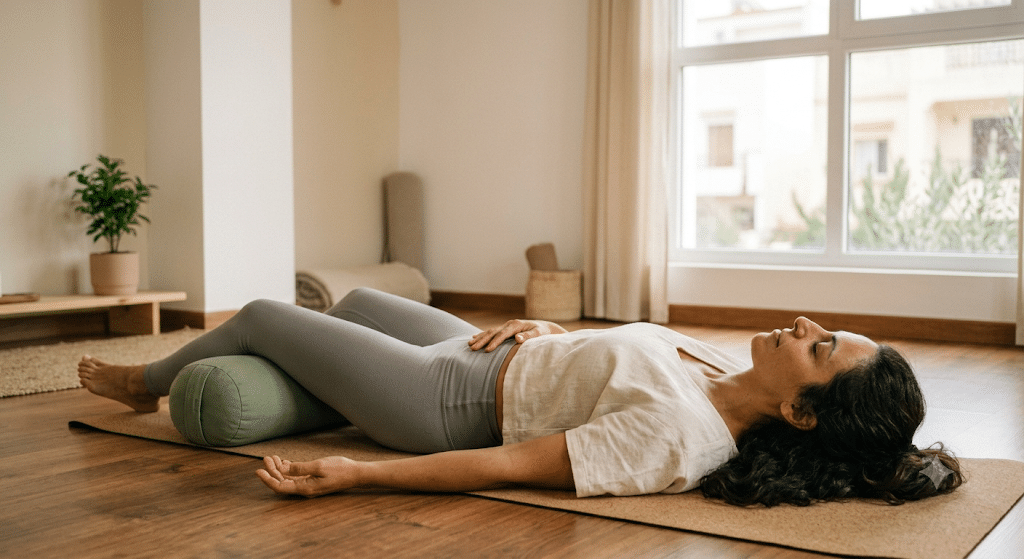
Placing a yoga bolster beneath the knees during somatic floor work completely changes the quality of the release — the lower back softens in a way that is almost impossible to achieve without that support.
For those who want to go deeper into the theory behind somatic yoga and why it works neurologically, I genuinely recommend keeping a good somatic yoga book nearby — understanding the science makes the practice land differently.
Key Takeaways
→ Somatic yoga prioritizes internal sensation over external shape, making it a fundamentally different experience from traditional yoga
→ Slowing movement down to the speed of sensation activates the parasympathetic nervous system and promotes lasting calm
→ Nervous system regulation is the central goal of somatic yoga, not a side effect
→ Somatic yoga is inherently trauma-informed, prioritizing choice and gradual titration over pushing through
→ Building interoceptive awareness — the ability to sense internal body signals — is at the heart of why somatic yoga creates lasting emotional regulation
Bringing It Together: You Do Not Have to Choose
Somatic yoga vs yoga does not need to be a battle. Many practitioners, myself included, weave both approaches into their lives — traditional yoga for strength, energy, and spiritual connection; somatic yoga for nervous system repair, trauma processing, and the particular kind of stillness that cannot be achieved by effort alone.
If you are new to somatic yoga, I suggest starting with just ten minutes of slow, sensation-focused movement before or after your regular practice. Notice what changes. Notice what your body begins to tell you when you give it space to speak.
The body holds extraordinary wisdom. Somatic yoga is simply the practice of learning to hear it.
Somatic yoga and traditional yoga are both pathways toward healing — and understanding the difference between them gives you the power to choose what your body actually needs right now. You do not need to abandon everything you have learned on the mat. You simply need to add a new kind of listening.
Perfection has no place in this practice. Consistency matters far more than getting it right, and gentleness with yourself is not optional — it is the method.
If something in this article resonated with you, I warmly invite you to try one somatic movement today. It does not need to be long. Five minutes of slow, attentive movement — with no goal except noticing — can genuinely shift how your nervous system feels by the end of the day.
Come explore more practices at SomaticYogaFlow.com, and if you have questions or a story to share, please leave a comment below. I read every single one.
Frequently Asked Questions
Is somatic yoga better than regular yoga for anxiety?
Somatic yoga tends to be particularly effective for anxiety because it directly targets the nervous system rather than treating anxiety as a mental problem to be managed. By working with slow, sensation-focused movement and building interoceptive awareness, somatic yoga helps the body complete incomplete stress responses that fuel anxious feelings. Many women find it reaches a layer of tension that traditional yoga, for all its benefits, does not fully address. That said, both practices have genuine value, and combining them is a perfectly valid approach.
What is the main difference between somatic yoga and Yin yoga?
Yin yoga involves holding passive poses for two to five minutes to target connective tissue, and while it is slow and introspective, the goal is primarily physical — lengthening fascia and improving flexibility. Somatic yoga, by contrast, uses gentle active movement to retrain the nervous system and release chronic muscular patterns held in place by stress or trauma. The internal focus of somatic yoga is much more explicitly therapeutic, and the movements are often far smaller and more exploratory than anything you would find in a Yin class.
Can beginners start with somatic yoga or do they need yoga experience first?
Somatic yoga is actually beautifully suited to beginners because it requires no prior yoga knowledge or physical flexibility. The practice meets you exactly where you are. Many of the movements are subtle enough to be done lying down or seated, and there is no correct way to do them — only your way, informed by your own sensation. Women who have never set foot on a yoga mat often find somatic yoga more accessible than traditional yoga precisely because there is no performance element involved.
How long does it take to feel the benefits of somatic yoga?
Many women notice something shifting within the very first session — a sense of quiet, a release of tension in the jaw or shoulders, or a breath that feels unexpectedly deeper. Sustained benefits, such as reduced anxiety, improved sleep, and a generally lower baseline of stress, tend to build over four to eight weeks of regular practice. Even ten minutes three times a week creates meaningful change over time, because you are essentially retraining the nervous system — and that kind of learning accumulates gradually and then, quite suddenly, it holds.
Is somatic yoga good for trauma recovery?
Somatic yoga can be a powerful support for trauma recovery, and it is one of the few movement practices specifically designed with trauma-informed principles built in. Because it emphasizes choice, slow titration, and following the body’s own signals rather than pushing through resistance, it avoids the risk of retraumatization that some find in more intense or directive yoga styles. However, if you are working with significant or complex trauma, somatic yoga works best as a complement to professional therapeutic support rather than as a standalone treatment.