
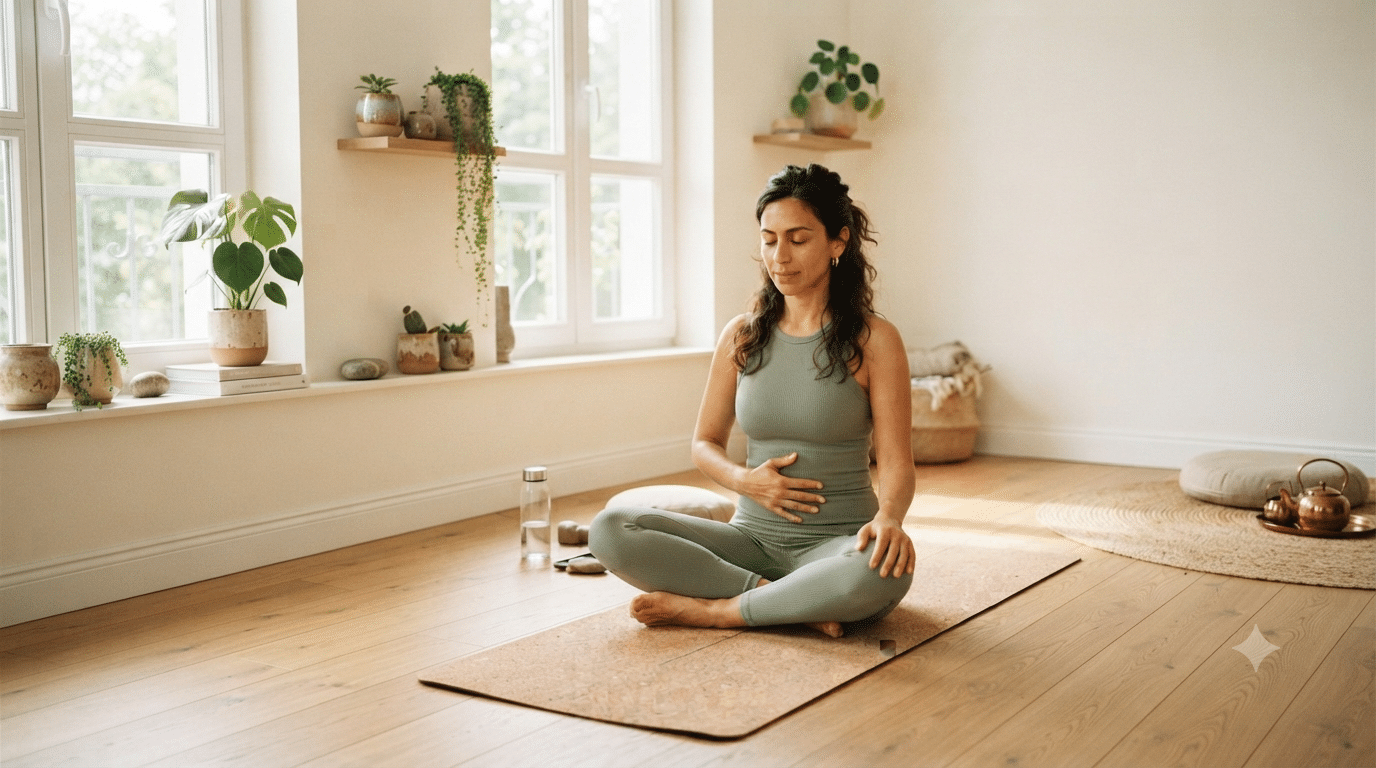
There is a specific kind of tired that has nothing to do with sleep. Your shoulders live somewhere near your ears. Your jaw aches by mid-afternoon, and you cannot remember the last time your body actually felt like a safe place to be.
I hear this from so many women in my community, and I want you to know that what you are feeling is not weakness or dramatics. Your body has been holding stress for you, quietly, for years, long before your mind caught up to what was happening. That tension is real, and it deserves a real answer.
Somatic movement is that answer for so many of us. It is a way of moving that helps your nervous system release what it has been storing, using slow, felt-sense awareness instead of force. By the end of this article, you will understand exactly what somatic movement is, why it works on a physiological level, and how to begin your own practice today.
Table of Contents
What Is Somatic Movement, Really?
Somatic movement is a category of body-based practice that uses slow, internally-felt motion to help the nervous system release stored tension and stress. The word “somatic” comes from the Greek soma, meaning “the living body in its wholeness,” and that distinction matters enormously. Traditional exercise often asks you to look at your body from the outside, focused on how it appears or performs, while somatic movement asks you to feel your body from the inside out.
This inward orientation is what makes somatic movement so different from a typical workout. You are not trying to achieve a shape or hit a rep count. Instead, you are tracking sensation as it moves through you, letting your nervous system lead rather than your mind.
The Science Behind Somatic Movement and Your Nervous System
Your nervous system does not just respond to stress in your mind. It stores stress physically, in patterns of chronic muscular tension that your brain eventually stops even registering as tension at all. This is sometimes called “sensory-motor amnesia,” a term used by somatic education pioneer Thomas Hanna to describe how the brain forgets it is holding a muscle contracted after prolonged stress.
Research supports what somatic practitioners have observed for decades. A review published in Frontiers in Psychology examined body-based interventions for stress and trauma and found that practices emphasizing interoceptive awareness, meaning your ability to sense what is happening inside your own body, were associated with meaningful reductions in self-reported anxiety and physiological markers of stress. This lines up with polyvagal theory, developed by Dr. Stephen Porges, which explains how slow, safe, rhythmic movement can signal to your vagus nerve that it is finally okay to shift out of fight-or-flight.
This is not abstract theory to me. It became deeply personal during a period when I was overworking myself into the ground, and my body simply would not calm down no matter how much I meditated. Somatic movement was the first thing that actually reached the parts of me my thinking mind could not talk to.
How Somatic Movement Differs From Traditional Exercise
Traditional exercise typically has an external goal: burn calories, build muscle, improve flexibility, or complete a set number of repetitions. Somatic movement has none of that. There is no correct depth, no ideal range of motion, and no performance to measure against anyone else in the room.
Instead, every movement is guided by a question. What does this feel like right now, and what does my body actually want to do next? Isn’t it strange how rarely we are taught to ask our own bodies that question?
Where a typical yoga class might push you toward a deeper stretch, somatic movement asks you to notice tightness and soften around it rather than force through it. This shift from doing to sensing is the entire foundation of the practice, and it changes how your nervous system responds to movement altogether.
The Core Principles of Somatic Movement Practice
Somatic movement rests on a small number of consistent principles, no matter which specific method you explore. Slowness is the first and most important one, because your nervous system needs time to actually register sensation rather than move past it. Speed keeps you in your head; slowness brings you back into your body.
Internal attention is the second principle, meaning your eyes are often closed or softly unfocused so your attention stays inward. Small range of motion is the third, since somatic movement frequently works in tiny, exploratory movements rather than large dramatic ones. Curiosity replaces correction here, because there is no wrong way to feel a sensation in your own body.
I always begin my own somatic sessions on a cork yoga mat, and the natural texture beneath my palms gives me an instant sense of being grounded that a synthetic mat has never quite replicated for me.
A Simple Somatic Movement Practice You Can Try Today
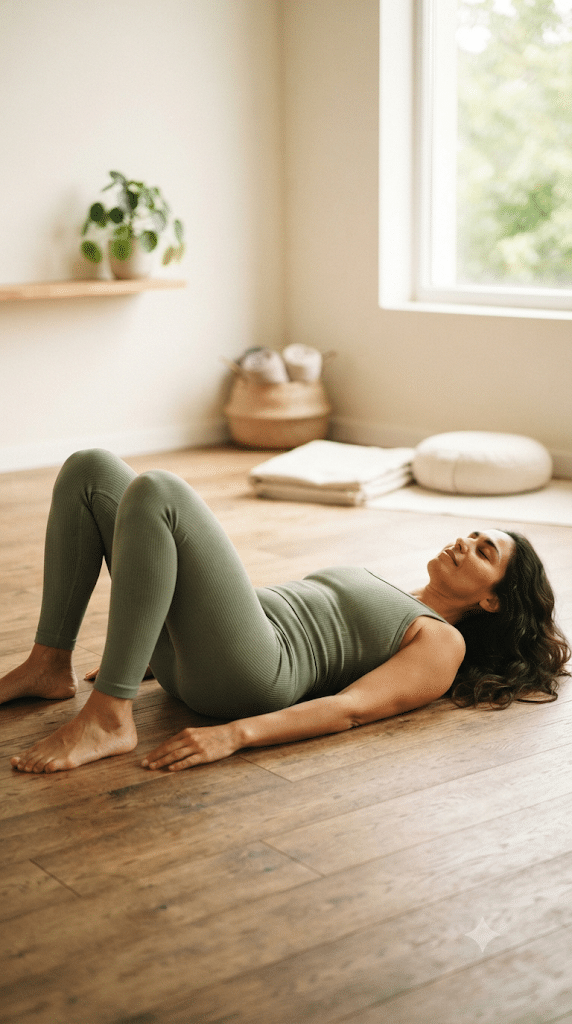
You do not need any special training to begin exploring somatic movement in your own living room. This short practice takes about ten minutes and works well lying on your back on a soft, supportive surface.
- Lie on your back with your knees bent and feet flat on the floor, then close your eyes and take three slow breaths without changing anything yet.
- Bring your attention to your lower back and notice, without judgment, whether it feels closer to the floor or lifted away from it.
- Very slowly, rock your pelvis a tiny amount, tilting it toward the floor and then away, moving at roughly one inch per breath.
- Pause anywhere that feels interesting or slightly uncomfortable, and simply breathe there for three full breaths before continuing.
- After several minutes, let your pelvis rest in a neutral position and notice what has shifted in your lower back and hips.
- Slowly roll to one side, pause, and take your time coming up to sitting rather than rising quickly.
💚 Sofia’s Tip: If your mind keeps wandering during this practice, that is completely normal. Gently narrate the sensation out loud, even just a whisper like “warmth in my hip,” to pull your attention back into your body.
Who Benefits Most From Somatic Movement
Somatic movement tends to resonate most deeply with people carrying chronic tension that has not responded well to stretching or strength training alone. Women navigating anxiety, burnout, or the physical aftermath of stress often describe it as the first practice that finally reaches the tightness that never seems to release. It is also widely used alongside trauma recovery, since it works with the body’s own pacing rather than pushing past it.
People managing chronic pain frequently find relief here too, because somatic movement addresses the muscular guarding patterns that keep pain cycling long after an initial injury has healed. If you have ever finished a “relaxing” yoga class still feeling wound up inside, this gentler approach may be exactly what your body has been asking for.
For anyone wanting to go deeper into the theory and history behind this work, I often recommend keeping a solid book on somatic yoga and polyvagal theory nearby, since understanding the “why” tends to make the practice itself feel far more intuitive.
Common Mistakes When Starting Somatic Movement
The most common mistake I see is rushing, which honestly makes sense in a culture that rewards speed everywhere else. People also tend to judge the sensations they notice, labeling tightness as “bad” instead of simply staying curious about it. Slowing down further is almost always the answer when a somatic practice feels unsatisfying rather than pushing harder.
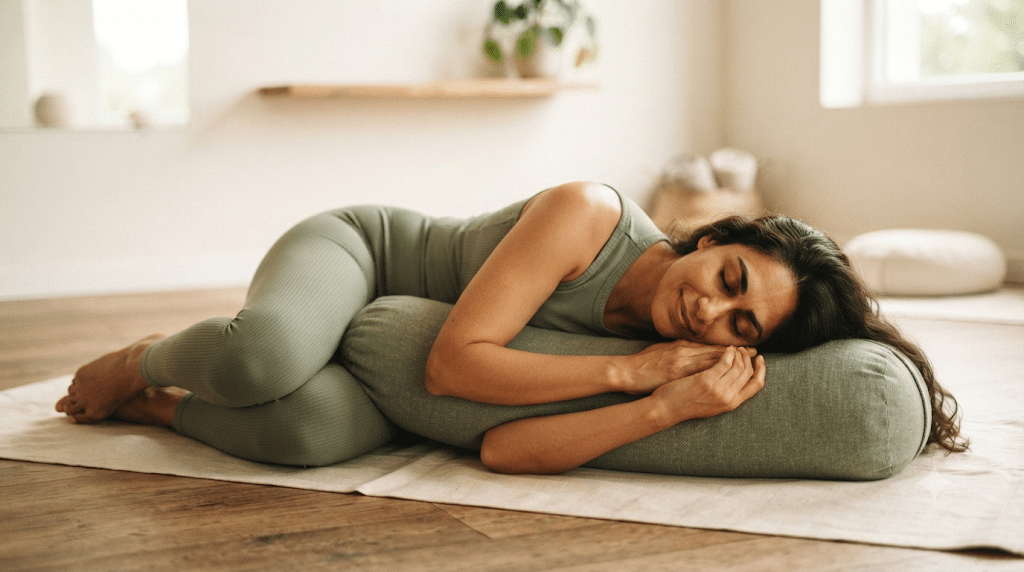
Another frequent misstep is skipping support altogether and lying directly on a hard floor, which can pull attention toward discomfort instead of subtle internal sensation. Placing a yoga bolster beneath your knees during floor-based somatic work changes the entire experience, allowing your lower back to soften in a way that feels almost effortless.
Bringing Somatic Movement Into Your Daily Life
Somatic movement does not require a full hour on your mat to be effective. Even ninety seconds of slow, internally-focused movement between meetings can interrupt a stress response before it fully takes hold. The goal is not another item on your to-do list, but a way of relating to your own body that you carry with you throughout the day.
Over time, many people notice they naturally begin catching tension earlier, often before it becomes pain or exhaustion. That early awareness is really the whole point of this work, and it tends to deepen the longer you stay with it.
Key Takeaways
→ Somatic movement works from the inside out, using felt sensation rather than external performance
→ It is grounded in real nervous system science, including polyvagal theory and interoceptive research
→ Slowness, small range of motion, and curiosity are the core principles of every session
→ A simple ten-minute floor practice is enough to begin feeling the difference
→ Consistency matters far more than intensity or duration
Conclusion
Somatic movement offers your nervous system something most exercise never does: permission to slow down and actually be felt from within. You do not need to master anything or move perfectly to benefit from this practice. What matters is showing up gently and consistently, letting your body lead a little more each time.
Start with just ten minutes today, lying down, breathing, and noticing. Your body has been waiting patiently for this kind of attention, and it will meet you exactly where you are. I would love to hear how it feels for you, so come share your experience over on SomaticYogaFlow.com.
Frequently Asked Questions
Is somatic movement the same as yoga?
Not exactly, though the two overlap significantly. Traditional yoga often includes set poses and sequences, while somatic movement is more exploratory and internally guided, without a fixed shape to achieve. Many somatic yoga classes, including the ones I teach, blend both, using yoga postures as a starting point and somatic principles to guide how you move through them.
Can somatic movement help with anxiety?
Yes, somatic movement can be genuinely helpful for anxiety because it works directly with your nervous system rather than only your thoughts. Slow, internally-focused movement helps shift your body out of a stress response and toward a calmer state. Many people find it complements talk therapy well, addressing the physical side of anxiety that words alone sometimes cannot reach.
How often should I practice somatic movement?
Short, frequent sessions tend to work better than occasional long ones. Even five to ten minutes daily can meaningfully change how your body holds tension over a few weeks. Consistency matters far more than duration, so a brief daily practice will generally outperform one long session per week.
Do I need experience to start somatic movement?
No prior experience is needed at all, which is part of what makes this practice so accessible. There is no correct way to feel a sensation, and no advanced pose to work toward. Beginners often find somatic movement easier to start than traditional yoga precisely because there is no performance pressure involved.
What is the difference between somatic movement and stretching?
Stretching typically targets a specific muscle to increase its length, while somatic movement targets the nervous system’s relationship to that muscle. A tight muscle often stays tight because the brain is holding it contracted, not because the tissue itself is short. Somatic movement releases that neurological grip, which is why relief often feels deeper and longer lasting than a typical stretch.