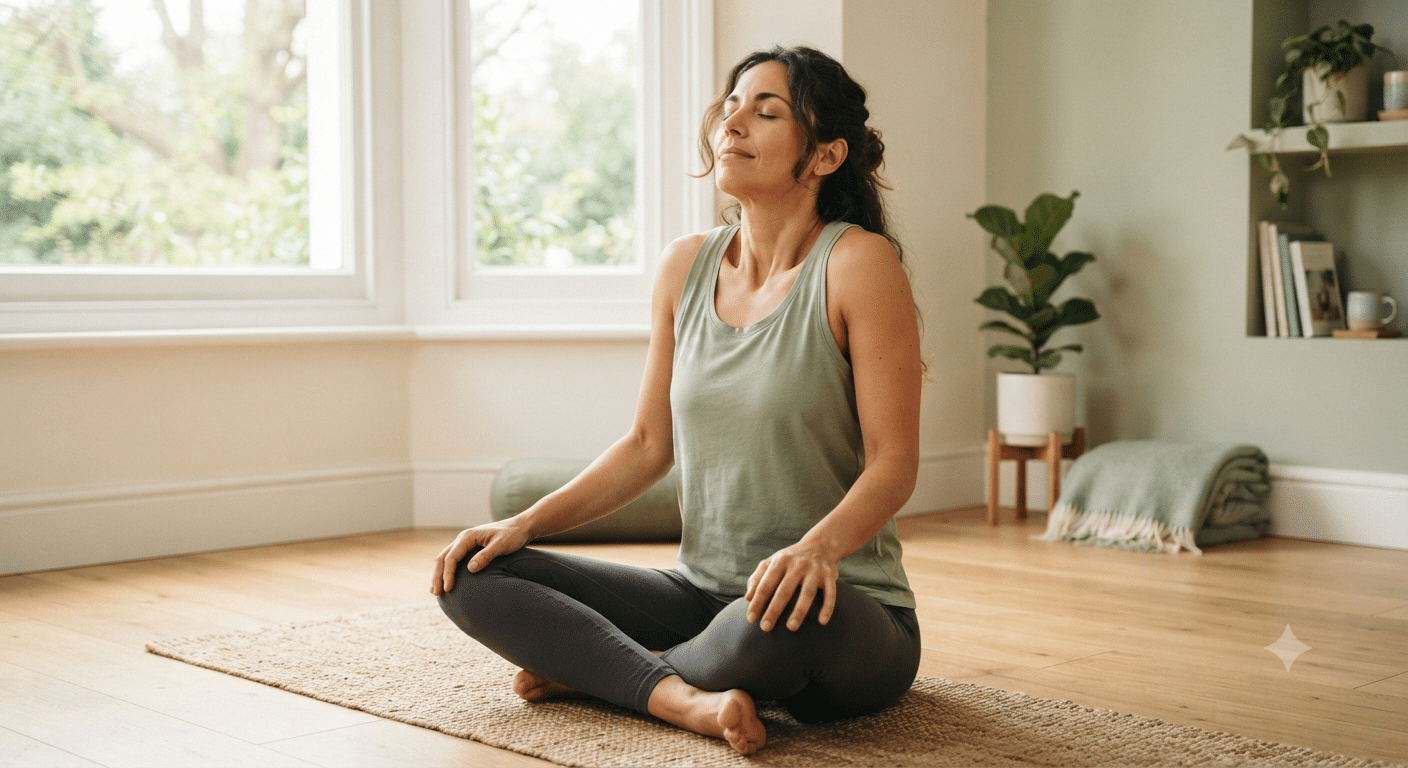
Your shoulders live somewhere up near your ears now. You notice it in the shower, at the stoplight, during the three seconds before you fall asleep — that low hum of tightness that never fully switches off.
You have probably tried stretching it away. You have tried yoga classes that move too fast for a nervous system already running on empty, leaving you more wound up than when you walked in. That is not a failure on your part — it simply means the approach was working against your body instead of with it.
Somatic yoga exercises take a different route entirely. Instead of forcing a stretch or chasing a perfect shape, these movements ask your brain and body to communicate again, slowly rebuilding the felt sense of safety that chronic stress erodes. In this article, I will walk you through exactly which somatic yoga exercises help the most, how to do them at home with nothing but a few quiet minutes, and how to build a simple daily practice that actually sticks.
Table of Contents
What Are Somatic Yoga Exercises and Why They Work
Somatic yoga exercises are small, slow movements guided by internal sensation rather than external appearance. You are not trying to look like the person on the yoga app next to you — you are simply noticing how your own tissue moves, resists, and releases.
This distinction matters more than it sounds. Traditional stretching pulls a muscle toward its end range, while somatic movement works from the inside, releasing the habitual muscle contraction patterns your nervous system has learned over years of stress.
Researchers at Stanford have found that slow, mindful movement combined with breath awareness measurably lowers activity in the amygdala, the brain’s threat-detection center, which helps explain why these gentle exercises calm the body so much faster than they seem like they should. Your body is not broken — it has simply been holding a pattern that it now needs permission to release.
I remember teaching a private client, a hospice nurse in her forties, who could not understand why her neck ached constantly despite stretching every single morning. Within two weeks of switching to somatic pandiculation instead of static stretching, her tension eased in a way years of yoga classes had never managed.
Somatic Yoga Exercises to Release Tension in the Neck and Shoulders
The neck and shoulders carry an enormous amount of unspoken stress, often becoming the first place tension shows up and the last place it leaves. These somatic yoga exercises target that region directly through small, deliberate contractions followed by full release.
Shoulder Roll Pandiculation
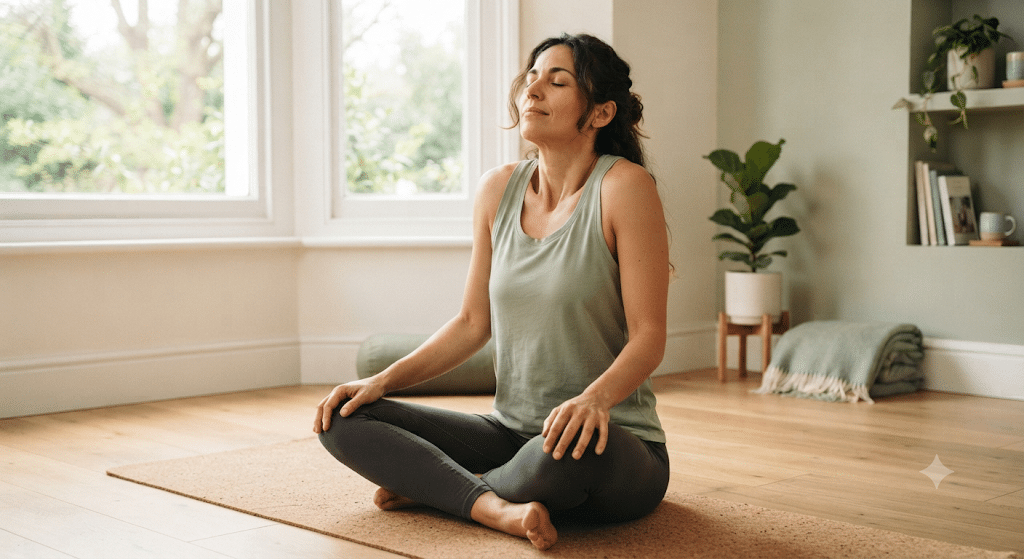
Begin seated with your spine tall and your hands resting on your thighs. Slowly lift both shoulders toward your ears, hold the contraction for a full three seconds, then release them down with a long, audible exhale. Repeat this five times, each time noticing how much further the shoulders drop than the time before.
Neck Arc and Release
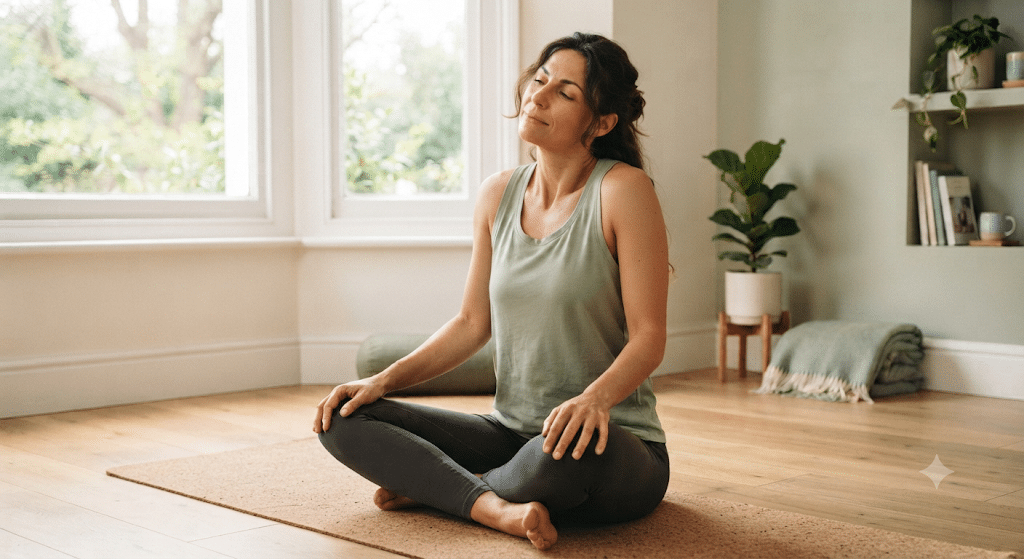
Turn your head gently to one side, pause, then let it drop slightly forward and arc across to the other side in one continuous, unhurried motion. This is not a stretch you push into — it is a slow investigation of where your neck naturally wants to move today.
Somatic Yoga Exercises for the Hips and Lower Back
Isn’t it strange how much emotional weight seems to settle directly into the hips? Many trauma-informed movement teachers, myself included, see the hips as a storage site for stress the mind has not yet processed.
💚 Sofia’s Tip: Never force a hip opener. If a position feels tight, back off by half and simply breathe there for thirty seconds before attempting anything deeper.
Windshield Wiper Release
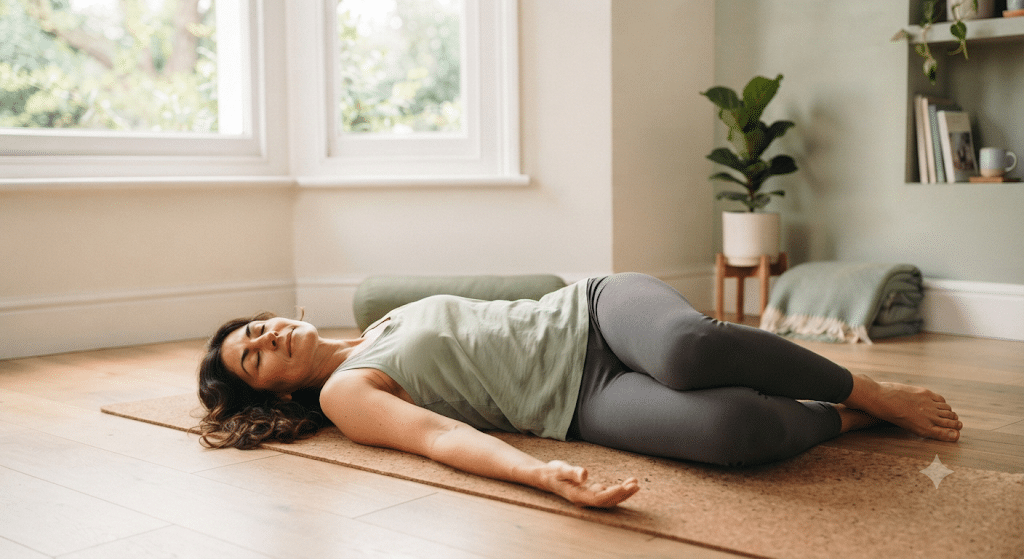
Lie on your back with your knees bent and feet flat on the floor, hip-width apart. Slowly let both knees fall toward one side, pause, then sweep them to the other side, keeping the motion smooth rather than snapping into either position. This somatic yoga exercise gently mobilizes the lower spine and hip flexors without any strain.
Pelvic Tilt Wave
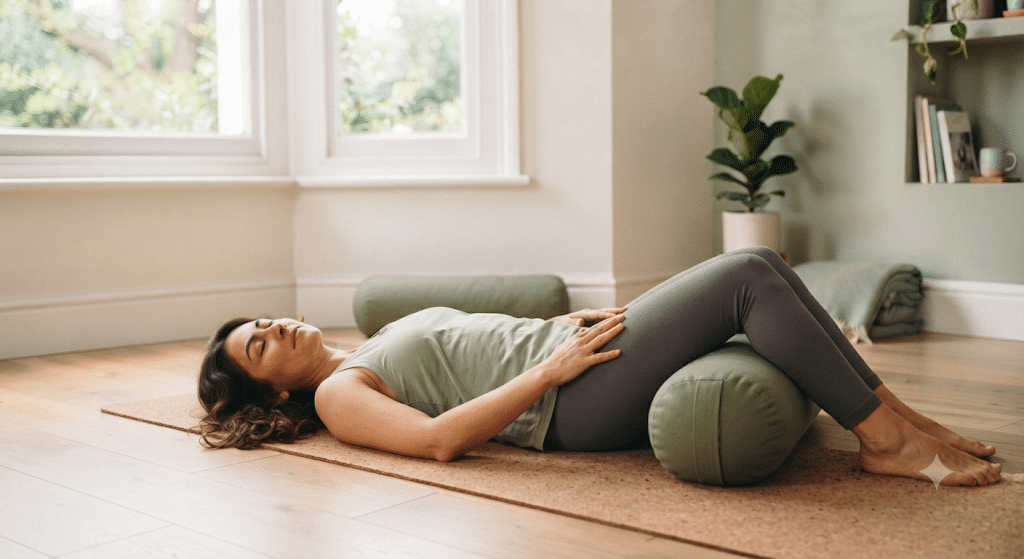
From the same position, tilt your pelvis to flatten your lower back into the floor, then reverse the movement to create a small arch. Move through this wave for ten slow repetitions, breathing out on the flattening phase and in on the arch.
A Simple Somatic Yoga Practice You Can Do at Home Today
You do not need a studio, special clothing, or thirty free minutes to feel a difference. Here is the exact sequence I give clients who are just beginning.
- Sit or lie down somewhere quiet and take three slow breaths, letting your exhale run longer than your inhale.
- Perform five rounds of shoulder roll pandiculation, contracting and releasing fully each time.
- Move into the windshield wiper release for eight slow rounds, letting your breath guide the pace.
- Follow with the pelvic tilt wave for ten repetitions, staying curious about where you feel resistance.
- Finish lying still for two full minutes, simply noticing the difference between how your body felt at the start and how it feels now.
- Close by placing one hand on your chest and one on your belly, taking three final breaths before you return to your day.
Most of my students are surprised that something this short creates such a noticeable shift, but that is exactly the point — somatic work rewards consistency over intensity.
Somatic Yoga Exercises for Deep Nervous System Regulation
What happens in your body when you finally stop bracing against the day? For many people, the answer is an almost immediate wave of fatigue, which is actually your nervous system downshifting out of a sympathetic state it has been stuck in for far too long.
A 2021 study published in Frontiers in Psychology found that slow somatic movement combined with breathwork significantly increased vagal tone, the physiological marker most closely tied to the body’s ability to self-soothe. This is not an abstract concept — it is the biological reason you feel calmer within minutes of practicing.
Body Scan With Breath
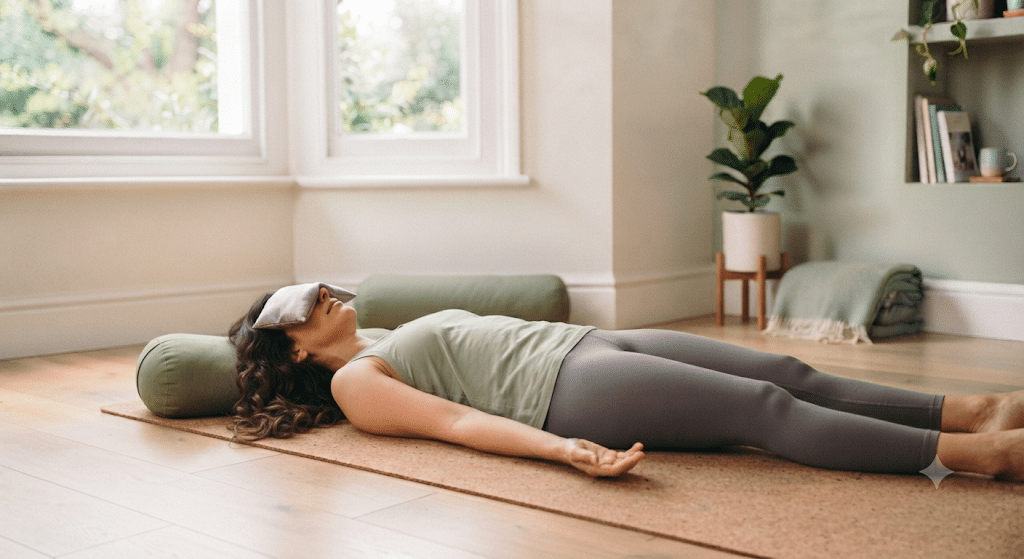
Lying comfortably, slowly bring your attention from your toes up to the crown of your head, pausing at each area to notice tension without trying to fix it. Placing a soft weight over your eyes here, such as an eye pillow, can help your nervous system settle even faster by gently signaling that it is safe to stop scanning the room.
Common Mistakes to Avoid With Somatic Yoga Exercises
The most common mistake I see is rushing. Somatic movement loses nearly all of its benefit when it is performed quickly, since the entire mechanism depends on giving your nervous system enough time to register the release.
The second mistake is comparing these exercises to a traditional yoga class and expecting a visible stretch. You are working with sensation, not shape, so a session that looks like almost nothing from the outside can still be doing significant internal work.
I always begin my own practice on a cork yoga mat, since the natural texture gives me an instant sense of grounding that synthetic mats simply cannot replicate, and it makes lying still for a body scan far more comfortable.
How Often Should You Practice Somatic Yoga Exercises
Consistency matters more than duration here. Five focused minutes every day will outperform one long session on the weekend, because your nervous system learns through repetition, not intensity.
For deeper restorative sessions, placing a bolster beneath your knees during the pelvic tilt wave completely changes the experience, allowing your lower back to release in a way that feels almost effortless.
Isn’t it worth five minutes a day if it means finally feeling at home in your own body again?
Key Takeaways
→ Somatic yoga exercises work through sensation, not stretching
→ Slow, repeated movement calms the amygdala and raises vagal tone
→ The neck, shoulders, and hips hold the most habitual tension
→ A short daily practice outperforms occasional long sessions
→ Props like a bolster or eye pillow deepen nervous system release
Somatic yoga exercises give your body permission to let go of patterns it has been holding for far longer than you realized. There is no need to be perfect here, no need to hit every step exactly right — just gentle, consistent attention is enough to create real change over time. Start with even one exercise from this list today, and notice how your body responds by tomorrow. I would love to hear how it feels for you, so come share your experience in the comments or explore more somatic practices at SomaticYogaFlow.com.
Frequently Asked Questions
What is the difference between somatic yoga and regular yoga?
Regular yoga typically emphasizes alignment, strength, and moving into specific poses, while somatic yoga focuses entirely on internal sensation and slow, exploratory movement. There is no “correct” shape to reach in somatic yoga, which makes it especially helpful for people recovering from chronic pain, stress, or nervous system dysregulation who need a gentler entry point into movement.
Can somatic yoga exercises help with anxiety?
Yes, many people find noticeable relief from anxiety through consistent somatic practice, since the slow movements help shift the body out of a sympathetic, fight-or-flight state. The physical release often brings a corresponding mental release, though somatic yoga works best alongside other support rather than as a sole treatment for clinical anxiety.
How long does it take to see results from somatic yoga exercises?
Many people notice a shift in tension within their very first session, though the deeper, lasting changes tend to build over two to four weeks of consistent daily practice. Because somatic work relies on repetition to retrain movement patterns, sticking with even five minutes a day will outperform sporadic longer sessions.
Do I need any equipment for somatic yoga exercises at home?
No equipment is required to begin, since these exercises rely on your own body weight and breath rather than props or machines. That said, a supportive surface like a yoga mat and a few comfort props such as a bolster or blanket can make certain positions easier to sustain.
Can beginners do somatic yoga exercises safely?
Somatic yoga is considered one of the gentlest and safest entry points into movement practice, since it never asks you to push into pain or force a stretch. Beginners are actually ideal candidates, because the slow pace and internal focus require no prior flexibility, strength, or yoga experience whatsoever.